Adult Industry Statistics: A 2026 Data Roundup
The most revealing adult industry statistic in the current data isn't a revenue forecast. It's the fact that mobile devices accounted for 87% of Pornhub visits in 2025, while desktop represented 11% and tablets 2%, according to Sextechguide's summary of Pornhub's 2025 Year in Review. That split changes how we should read almost every other number, from audience composition to session behavior and the commercial value of a visit.
I'm Jill Hills, and I approach adult industry statistics as measurements with boundaries, not as magic answers. The figures below can clarify the market, but only when we ask what each source counted, which users it could observe, and what its definition of “adult entertainment” included. Conflicting estimates aren't automatically evidence that someone is lying. They often reveal an industry spread across subscription platforms, creator businesses, cam services, streaming sites, premium clips, advertising, and adjacent technology.
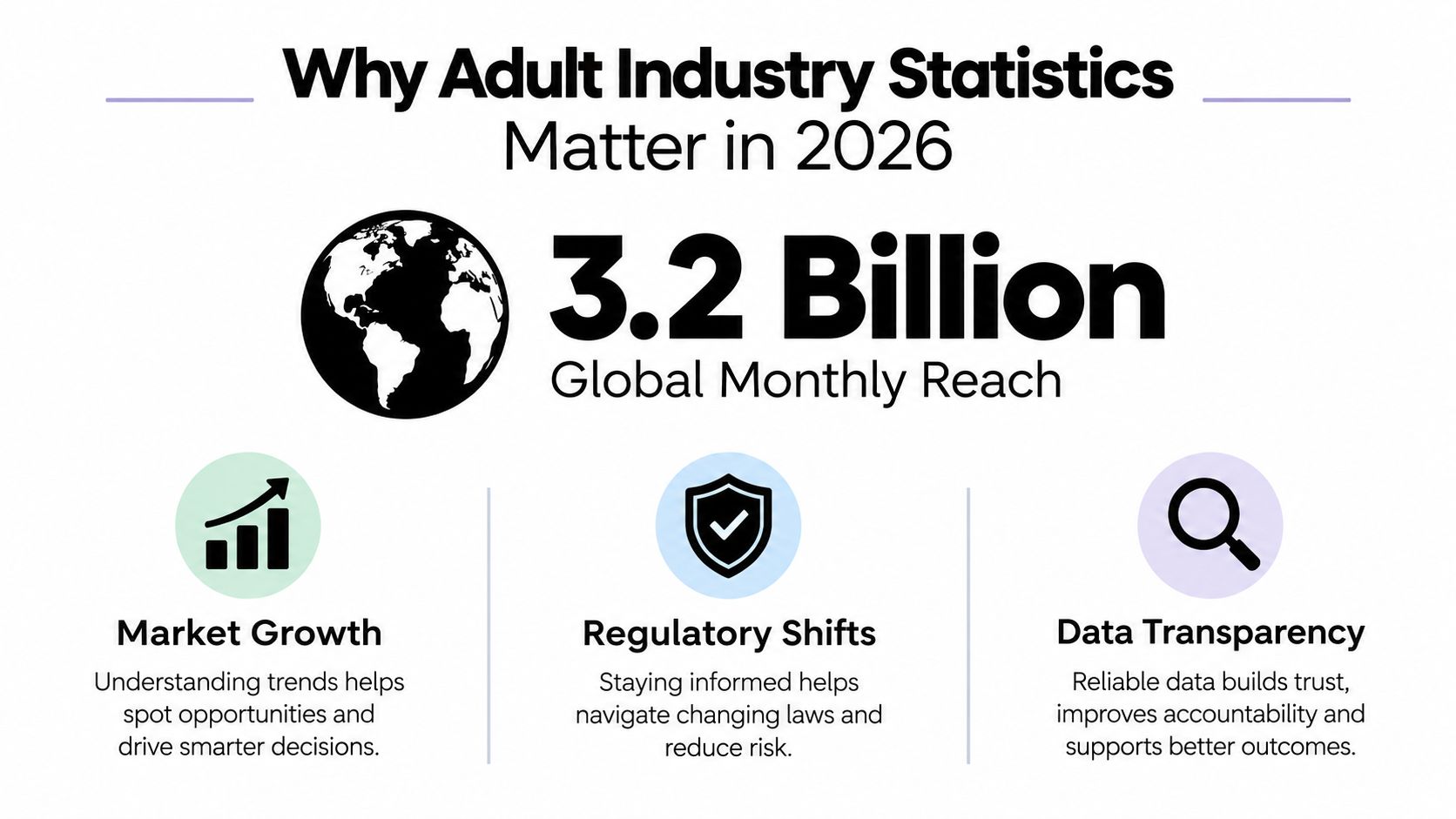
Why Adult Industry Statistics Matter in 2026
A large market can still be poorly measured. The global adult entertainment market has been estimated at US$61.1 billion in 2024, with a projection of US$74.7 billion by 2030, according to Research and Markets. That estimate implies about 22% growth across the period and a 3.4% compound annual growth rate, but it doesn't describe every transaction or every platform equally.
The stakes have changed because the infrastructure around adult content is changing. Age-verification requirements can add identity checks before access. Payment processors can alter which businesses or content categories they'll support. Mobile-first platforms can generate behavioral data that looks very different from the desktop-era metrics publishers once relied on. A traffic visit, a paying subscriber, a creator transaction, and a platform impression are not interchangeable units.
Start with the measurement question
Before trusting a headline, I use three checks:
Define the universe: Does the estimate cover online video only, or does it also include cam platforms, subscriptions, sextech, retail, and sexual wellness?
Identify the unit: Is the source counting visits, users, sessions, views, gross sales, net platform revenue, or creator earnings?
Check the observer: Is the data self-reported by a platform, modeled by a research company, or collected through a third-party measurement system?
That discipline matters because the adult sector has no single central reporting body that publishes a complete, universally accepted ledger. Private companies protect commercial information, businesses operate across jurisdictions, and payment flows can pass through several intermediaries. A report may be useful within its stated scope while still being unsuitable for a claim about the entire industry.
Practical rule: Treat every adult industry statistic as a scoped observation, not a census.
This roundup focuses on figures with identifiable sources and explicit caveats. It separates market estimates from platform analytics, demographic signals from regional conclusions, and regulatory mechanisms from assumptions about user behavior. The aim isn't to force the data into one clean story. It's to show why the mess itself is informative.
The Global Market Size and Why Estimates Conflict
Headline figures range from tens to hundreds of billions of dollars because researchers are often measuring different markets. One Research and Markets estimate values global adult entertainment at US$61.1 billion in 2024, with a projection of US$74.7 billion by 2030. Its emphasis on streaming, subscriptions, and digital distribution makes it useful for evaluating online business models, but it does not automatically represent every related category.
A separate Global Adult Entertainment Market Report reports US$58.4 billion in 2022 and projects US$96.2 billion by 2032. The Research and Markets market overview presents a much broader estimate of US$296.21 billion in 2025, rising to US$536.61 billion by 2031. That page also cites an alternative estimate of US$67.17 billion in 2025 and US$108.71 billion by 2033.
Source / Report | Year | Scope | Headline Estimate |
|---|---|---|---|
Research and Markets, Global Strategic Business Report | 2024 | Global adult entertainment, with digital and recurring-revenue models | US$61.1 billion |
The Business Research Company, Global Market Report | 2022 | Global adult entertainment market | US$58.4 billion |
Research and Markets, market overview | 2025 | Broad market estimate | US$296.21 billion |
Research and Markets, cited alternate estimate | 2025 | Differently scoped global market estimate | US$67.17 billion |
Why the gap matters
“Adult entertainment” may refer to paid video and subscriptions, or to a wider commercial ecosystem that includes cam services, creator platforms, sextech hardware, sexual wellness retail, advertising, and related activity. Adding these categories changes the market boundary before any forecasting begins.
Revenue treatment creates a second divide. Gross consumer spending exceeds the amount a platform retains after creator payouts, payment costs, refunds, and operating expenses. A gross transaction estimate therefore cannot be compared directly with platform revenue.
Private-company opacity makes reconciliation harder. Major services may not publish complete financial statements, while offshore structures and alternative payment rails can obscure the path from consumer payment to reported revenue. Large estimates are not automatically wrong. Their precision is limited when the underlying categories and flows cannot be independently checked.
The practical conclusion is narrow. Use lower, more tightly defined estimates for identifiable digital entertainment revenue. Use broader figures only when the report names its adjacent verticals and explains its modeling choices. The useful statistic is not the largest headline. It is the estimate whose boundaries match the question.
Traffic, Devices, and How People Actually Watch
Mobile accounted for 92.1% of visits to Pornhub in 2023, compared with 7.9% on desktop. By 2025, the breakdown reported by Sextechguide was 87% phone visits, 11% desktop visits, and 2% tablet visits. The figures cover different years and reporting snapshots, so they should not be treated as a single trend series. They do establish a clear operating condition: mobile is the primary environment for discovery, selection, and viewing on this platform.
Platform reporting answers a narrower question than market research. Pornhub's annual Year in Review provides recurring observations about traffic, devices, geography, and search behavior within one large service. It does not measure the full adult internet, and its audience may differ from users of subscription platforms, creator services, or sites with different access policies.
A mobile-first audience changes the product task. Smaller screens, touch navigation, uneven connection quality, privacy-sensitive browsing, and short discovery sessions all affect how users encounter content. Thumbnails, filters, labels, recommendations, and video formats must compete within limited interface space.
Vertical video suits a phone screen, but mobile use does not necessarily mean brief sessions. Pornhub's 2025 reporting placed average engagement time at 9 minutes and 33 seconds. 18 to 24-year-olds were below that average, while users aged 65 and older were above it, according to the official 2025 Year in Review. Device share and engagement time measure different behaviors, so neither statistic can stand in for the other.
A visit shows that a user arrived. It does not show why they arrived, what they watched, whether they returned, or whether the visit generated revenue.
Geographic rankings and seasonal spikes require the same caution. They describe observed activity on a particular platform, not total consumption in a region. Legal restrictions, payment access, search habits, and platform availability can change which users appear in the dataset.
For creators and product teams, the practical response is mobile discovery without assuming uniform attention. Interfaces need fast content identification, clear labeling, accessible controls, and recommendations that support both quick searches and deliberate browsing. For a local media interpretation of the latest reporting, see Circle City News' coverage of Pornhub's 2025 Year in Review.
Demographic Shifts Reshaping the Audience
Platform data increasingly conflicts with the old assumption that adult-content audiences are mainly male and young. Pornhub's 2025 Year in Review found that women represented 38% of its traffic, up 1.5 percentage points from 2024 and higher than 24% in 2015, according to the official report. XBIZ reports the same long-term shift.
The finding describes one platform's observed traffic, not the entire market. Even so, it has direct product implications. Services built around male-user assumptions may rank content, write labels, and set search defaults in ways that underserve other viewers. A larger share of women does not imply a single set of preferences. It does make one-size-fits-all design harder to defend.
Search behavior points to further diversification. Pornhub reported that “transgender” searches rose 58% globally, “femboy” entered the global top 10, and “lesbian” became the most-viewed category in 2025. These figures measure searches and category activity on one platform, not the full size of LGBTQ+ audiences. They still show that identity terms can shape discovery rather than occupy a peripheral role.
The downstream effects
Three pressures follow from that shift:
Recommendation systems must distinguish audience growth from audience sameness. A growing category can contain several distinct interests, so ranking models need behavioral signals beyond broad demographic labels.
Creators face opportunity alongside saturation. Popular identity terms may improve discovery, while crowded tags increase the value of accurate labeling and clear niche positioning.
Policymakers need evidence before imposing rigid user assumptions. Rules designed around one imagined audience can add friction for adults without resolving the limits of verification systems.
Age further complicates interpretation. The 2025 report found shorter average engagement among younger users and longer average engagement among users aged 65 and older. That pattern does not establish a universal age profile for the industry, but it weakens the assumption that adult-platform behavior belongs primarily to young adults.
The geographic question requires restraint. Available findings are global and platform-level, not a reliable demographic table for Indianapolis or the broader Midwest. No defensible conclusion about Indiana users' age or device habits follows without local data. National and global averages should therefore remain benchmarks, not portraits of Indianapolis.
For a separate examination of gendered consumption assumptions, see Circle City News' analysis of how men and women consume online adult content.
Age Verification, Payments, and Policy Pressure
Age verification is no longer a simple checkbox. Current research describes it as a central regulatory instrument intended to prevent minors from entering adult-content services, while also highlighting privacy and cybersecurity trade-offs in the implementation. The University of Strathclyde research on age verification is useful because it focuses attention on system design rather than treating verification as one uniform technology.
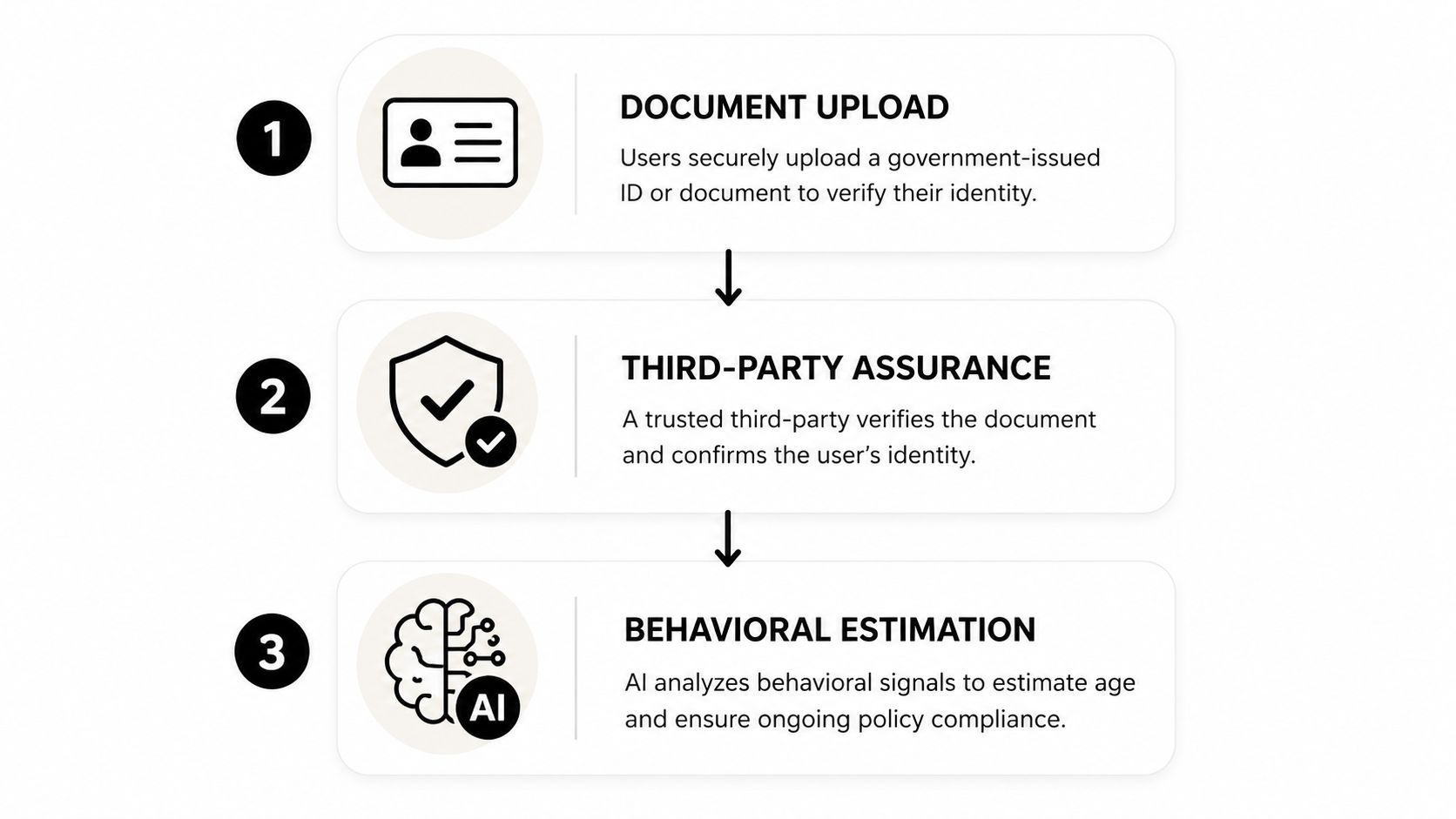
A practical way to understand the options is to separate three layers:
Document upload asks a user to provide an identity document. This can offer a direct age signal, but it also creates sensitive-data questions about collection, retention, access, and breach exposure.
Third-party identity assurance moves the check to an external provider. That may reduce the platform's direct handling of documents, but it introduces another organization, another data relationship, and another point of failure.
Device or age-estimation layers attempt to infer age through technical or behavioral signals. These may reduce document friction, yet estimation can raise accuracy, bias, explainability, and false-positive concerns.
Follow the data, not just the rule
The critical questions are operational. What leaves the user's device? Who stores it? How long is it retained? Can the platform use the information for another purpose? What happens when a legitimate adult is rejected? A compliant system can still damage trust if users can't understand its data practices.
Age verification also changes the metrics platforms should monitor. A decline in visits might reflect reduced access, failed checks, abandonment during onboarding, or a genuine change in demand. Without separating those causes, traffic data can turn a policy effect into a misleading audience narrative.
Payments create a parallel constraint. When processors restrict or monitor adult-content transactions, independent creators may lose familiar settlement options even when their content business remains active. The payment layer therefore affects what gets measured as revenue, not only what gets published.
The policy debate needs technical specificity. Lawmakers should evaluate verification architecture, privacy safeguards, appeal processes, and enforcement consistency together. Readers interested in the creator-payment side can see Circle City News' explanation of how OnlyFans payments work.
Common Misconceptions the Numbers Bust
Headline statistics correct familiar shortcuts, but they do not settle every question. The more useful test is whether a claim explains how the figure was collected, who it excludes, and whether policy or platform design shaped the result.
Myth, the audience is almost entirely young men. Gender labels drawn from one platform cannot describe the whole market. The 2025 findings summarized in XBIZ's report challenge that stereotype, while leaving open questions about age, geography, identity, and users who avoid disclosure.
Myth, mobile users only consume quick clips. Device data shows access method, not motive. A session may reflect browsing, repeat viewing, or deliberate discovery, so analysts should not convert device share into a simple assumption about attention or intent.
Myth, women rarely use major platforms. Public discussion often treats male-oriented branding as evidence of male-only demand. That inference confuses a platform's presentation with its audience and can distort decisions about content, moderation, and advertising.
Myth, LGBTQ+ discovery is peripheral. Search rankings reveal interests that broad demographic categories can conceal. They still measure queries rather than the full audience, and search volume does not by itself establish loyalty, conversion, or creator income. The official Year in Review is therefore useful evidence, not a complete market census.
Myth, VPNs make age-verification rules irrelevant. Workarounds may change who appears in access data, while verification still affects privacy exposure, abandonment, and platform costs. A traffic decline needs those mechanisms separated before it is interpreted as falling demand.
Myth, creator platforms have replaced studio production. Conflicting market estimates usually combine different sectors and revenue definitions. That disagreement points to a fragmented market, not a clean replacement, and any conclusion should state what the estimate counts.
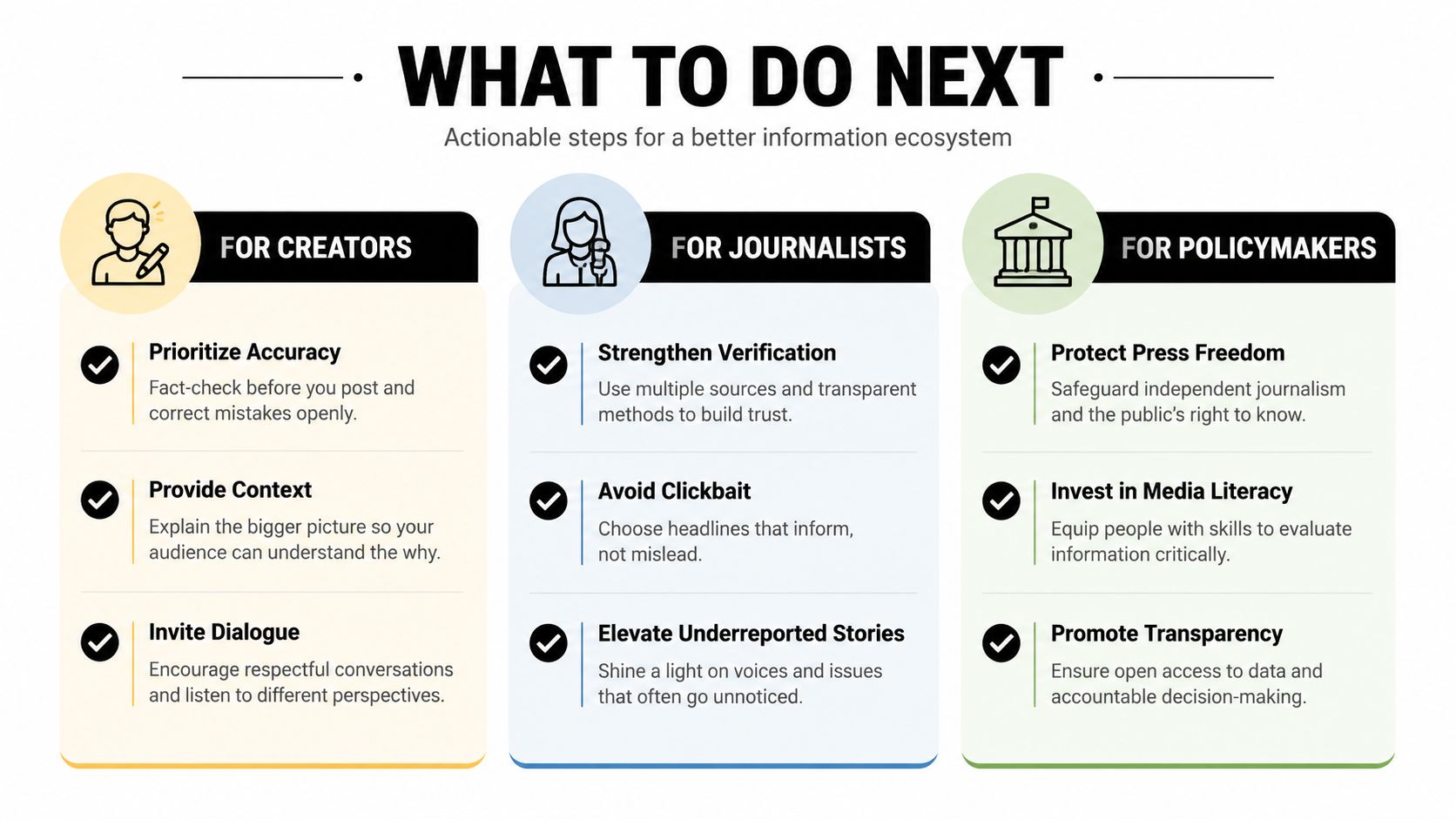
What Creators, Journalists, and Policymakers Should Do Next
Creators should treat platform visibility as variable inventory, not guaranteed income. Mobile discovery, payment restrictions, identity checks, and shifting audience interests can all affect access to a single channel. Diversifying across subscriptions, direct payments, and carefully selected niche platforms can reduce dependence on any one algorithm or processor, although each channel carries its own terms and risks.
Journalists need to ask four questions before publishing a number:
Who collected it? A platform's first-party report and an independent market model answer different questions.
What does it count? Visits, sessions, users, gross sales, and retained revenue aren't substitutes.
What geography does it cover? A global estimate can't automatically describe Indiana or Indianapolis.
What was excluded? Adjacent sectors can materially change the headline total.
Policymakers should apply the same discipline. Age-verification rules should reflect actual technical choices, including document handling, third-party reliance, estimation limits, privacy protection, and adult appeal rights. Payment restrictions deserve scrutiny because they can reshape creator access without appearing in standard traffic statistics.
Indianapolis provides a relevant local setting for these questions. Indiana's 2024 age-verification law and continuing enforcement debates put local residents, platforms, creators, and policymakers close to the national dispute over privacy, access, and platform responsibility. I won't infer local behavior from global platform data, but I will say that Indiana is a useful place to test whether policy outcomes match the assumptions behind the rules.
Over the next year, I'd watch device mix, verification abandonment, demographic composition, search-category movement, payment availability, and the gap between gross consumer spending and reported platform revenue. Those indicators can reveal structural change more clearly than a single market-size forecast.
Circle City News™ covers adult entertainment, sex, crime, policy, and local Indianapolis issues with data-informed reporting and candid analysis. Visit Circle City News™ to follow the latest industry trends, legal debates, creator-economy developments, and podcast coverage.
Comments