Indianapolis Sex Offender List: 2026 Guide for Residents
The official Indianapolis sex offender list is the Indiana Sex and Violent Offender Registry, a statewide online system administered by the Indiana Department of Correction. Indiana's framework uses 10-year and lifetime registration periods, depending on the offense and classification.
You may be checking the registry before moving to a new neighborhood, reviewing a route your child takes to school, or trying to understand a result that appeared on a map. I'm Jill Hills, and I've written this guide to make that process practical without losing sight of the people and legal obligations involved. The registry can support informed safety decisions, but it isn't a license to harass, threaten, or publicly shame anyone.
Understanding the Official Registry Resource
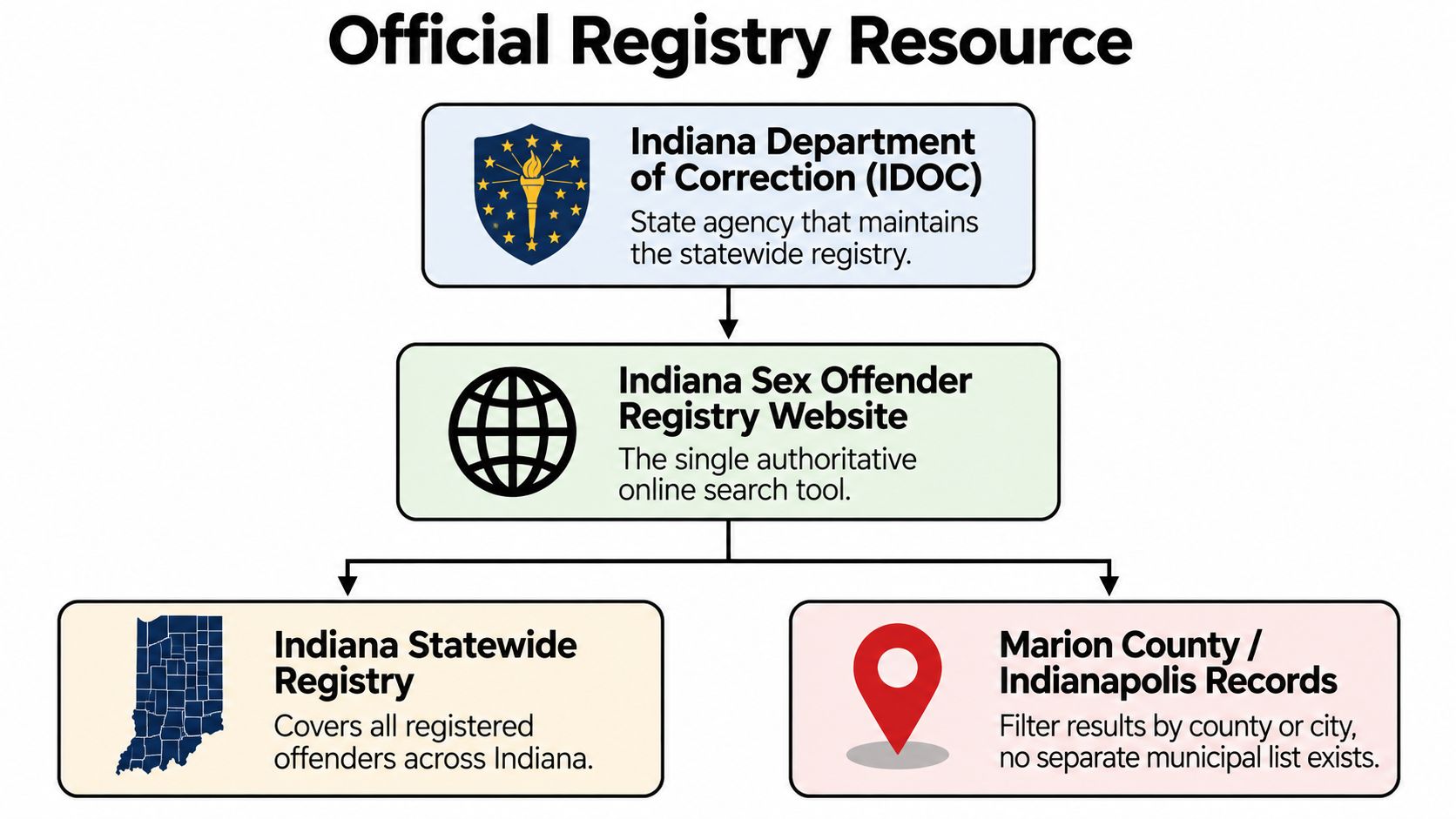
If an Indianapolis address appears in a search result, start with Indiana's statewide Sex and Violent Offender Registry, not a city-maintained list. The Indiana Department of Correction administers the statewide system, while the Indianapolis Metropolitan Police Department is the relevant local law-enforcement agency for applicable registration matters. Use the Indiana Department of Correction registry resource as the official entry point.
Search results and map views serve different purposes. A record may show identifying details, location information, appearance, offense information, and compliance status. A map helps you understand where a result falls geographically, but it may display only a simplified view. Open the individual record before relying on any detail.
Practical rule: Search the official record, not a screenshot, social-media post, or third-party map.
The registry is intended to provide identifying, location, and appearance information about people who live, work, or study in Indiana. Use that information for situational awareness and lawful safety planning. An entry does not prove that someone is at a specific address when you search, nor does it describe every circumstance related to a conviction.
For an Indianapolis search, choose the geographic filters that match your question, open each relevant record, and record the access date. Review the address and status fields carefully, since reposted or incomplete information can create confusion. Use the registry to make informed decisions, never to threaten, harass, or publicly shame anyone.
Legal Framework and History of Indiana's Registry
Indiana's registry began with Zachary's Law, enacted in 1994 after the 1993 molestation and murder of 10-year-old Zachary Snider in Cloverdale. The original law required people convicted of certain sex offenses to register with local authorities and permitted public notification. Eight offenses initially triggered registration, and the law applied to people who lived or intended to live in Indiana.
A 1999 amendment made registry information available online, changing public access to the system. Effective January 1, 2003, county sheriff departments had to establish the statewide Sex and Violent Offender Registry jointly. The Indiana Department of Correction assumed statewide oversight on July 1, 2006. These changes matter for Indianapolis residents because the registry's present format developed through legislation, local administration, and later statewide coordination.
According to the Indiana appellate decision discussing Indiana's registry history, the number of triggering offenses increased from eight to 21. The scope also expanded beyond sex crimes to include certain killings, kidnapping, and criminal confinement. A listing therefore does not automatically describe the same type of conduct in every case. Read the offense category and legal details rather than relying on the registry's title alone.
The registry is a statutory public-information system, not a complete account of someone's criminal history. Legislation and court decisions can change its categories, publication rules, and registration duties. Use an entry as a legal record requiring context, not as a moral label. For Indianapolis safety planning, confirm the relevant details and avoid drawing conclusions beyond what the record states.
Navigating the Search Interface and Data Fields
Start at the official Indiana registry website rather than a commercial search page. Choose the search method that matches your question:
Name search: Use the person's known name and review possible aliases or similar results carefully.
Geographic search: Filter by county or ZIP code when you're evaluating a home, workplace, school route, or activity area in Indianapolis.
Record review: Open the complete entry instead of relying on a pin, thumbnail, or abbreviated result.
Date check: Record when you accessed the information, since an online record is a snapshot.
The record may contain physical identifiers, aliases, government identification details, vehicle information, qualifying addresses, and offense information. Indiana's reporting framework can also account for work, school, volunteer, and other jurisdictional relationships. A listed address is not automatically proof of a person's present location, especially when the entry shows a compliance concern or when the person's circumstances are changing.

Reading compliance information carefully
Look for the record's compliance status and related update information. A non-compliant status can mean the address or other information hasn't been verified as required. It doesn't give you permission to investigate the person yourself. If you believe an entry is inaccurate, contact the responsible law-enforcement agency and provide the factual basis for your concern.
The registry isn't the same thing as a court-docket search. If you need procedural information about a case, use a properly identified court record and understand that court files can require different search methods. This guide to an Indianapolis court records search can help distinguish registry information from court documents.
A short video can help first-time users orient themselves to online public-record searches:
Don't copy addresses into neighborhood groups or publish unnecessary personal details. Search for a defined safety purpose, retain only what you need, and use official channels for corrections.
Registration Durations and Offense Classifications
Indiana uses two principal registration durations, 10 years and lifetime. The 10-year period generally runs from the latest of release from incarceration, placement in community corrections, parole, or probation for the offense. Incarceration can toll, or pause, the registration period. The Indiana county registration guidance explains how the statewide framework operates in practice.
Lifetime registration applies to categories that include sexually violent predators, people convicted of sex offenses against victims younger than 12, and offenders whose crimes involved force or the threat of force. A registry entry therefore can't be interpreted correctly by looking only at a person's name or the existence of a map marker. The classification and legal basis for registration matter.
Why the offense category matters
Indiana's registry reaches beyond one narrow group of offenses. The statutory framework covers certain sex offenses and specified violent conduct, including some killings, kidnapping, and criminal confinement. That breadth is one reason the official record should be opened and read rather than summarized through a third-party label.
Out-of-state convictions can also matter. Indiana courts have held that an out-of-state conviction may require registration when the underlying conduct is substantially similar to an Indiana registrable offense. The obligation can attach to a person who resides, works, or attends school in Indiana, not only to someone with a permanent Indiana residence.
These rules make the registry useful for identifying registration obligations, but they limit what a casual search can tell you. Registration duration isn't a complete measure of present risk, rehabilitation, or compliance. It's a legal classification that must be separated from assumptions about a person's current conduct.
Verification Schedules and Reporting Deadlines
A registry entry reflects information gathered under reporting and verification rules, but those rules don't create a live tracking system. A registrant who changes address across Indiana counties must report in person to the authority responsible for the current address and, when applicable, the new county no later than 72 hours after the change. The receiving local authority must verify the address within seven days after receiving notice, according to Indiana county guidance available through the Randolph County Sheriff's registration information.
Indiana also uses a specific rule for additional living locations. A registrant must report an address where they spend more than seven nights in a 14-day period. That requirement helps explain why a single Indianapolis address search may not capture every relevant location or jurisdictional relationship.
Verification schedules vary by classification. Jefferson County's official guidance states that the sheriff must verify registration information at least annually or every 90 days, depending on risk classification. A person who is homeless or living in temporary or transitional housing must register every seven days, according to the same guidance at the Jefferson County registry page.
A registry entry is best understood as dated public information, not a guarantee that a person is standing at the listed address now.
These deadlines create a practical limitation. A record may be accurate when verified and still become outdated during a move, temporary stay, or reporting delay. Save the access date, read compliance information, and report suspected inaccuracies to law enforcement. Don't attempt independent contact, surveillance, or public confrontation.
Ethical Considerations and Legal Responsibilities
Public access doesn't eliminate personal responsibility. The Indianapolis sex offender list exists for safety information, but using it to threaten, stalk, intimidate, or organize harassment can create harm and potential legal consequences. Sharing a person's address, workplace, vehicle information, or image beyond a legitimate safety need can expose details that neighbors never needed to know.
I recommend a narrow-use standard: search because you're evaluating a specific safety situation, interpret the official record carefully, and act through lawful channels. Don't knock on a registrant's door, confront family members, contact an employer to cause punishment, or encourage online retaliation. A registry status also shouldn't become an automatic reason to deny housing, employment, education, or ordinary community participation without a lawful, individualized basis.

Separate awareness from punishment
The registry gives the public certain identifying and location information. It doesn't authorize residents to impose additional punishment. It also doesn't replace a court, a police investigation, a probation officer, or a child-protection professional.
If someone posts threats or targets a registrant online, document the conduct without amplifying it and use an appropriate reporting channel. This resource on how to report online harassment offers practical direction for preserving evidence and escalating abusive online behavior.
Ethical use protects everyone's safety. It helps parents and neighbors identify relevant information while reducing misinformation, vigilantism, and collateral harm to relatives who aren't part of the legal record. The strongest response to a concern is specific, calm, and directed to the agency with authority to act.
Practical Applications for Parents and Caregivers
Parents usually search the registry because they're making a concrete decision: where a child walks, which park to visit, or whether a new home warrants closer safety planning. Use the tool to understand the surroundings, not to frighten children with adult legal details.
Start by checking the neighborhood, then consider the child's actual routines. A home-address search may be less useful than reviewing the path to school, a recreation center, a relative's home, or a regular park. The registry can inform that review, but it can't replace supervision, communication, or clear boundaries.
Turn information into family habits
Search purposefully: Review the official record when evaluating a location or routine, and write down the access date.
Map routines: Look beyond the front door. Consider walking routes, pickup points, playgrounds, and places where children spend unsupervised time.
Teach boundaries: Explain that children can refuse unwanted touch, leave uncomfortable situations, and tell a trusted adult. Keep the language age-appropriate.
Avoid fear-based labels: Don't tell children that every unfamiliar adult is dangerous. Teach behavior-based safety rules, including how to respond when someone asks them to keep a secret or move away from a trusted adult.
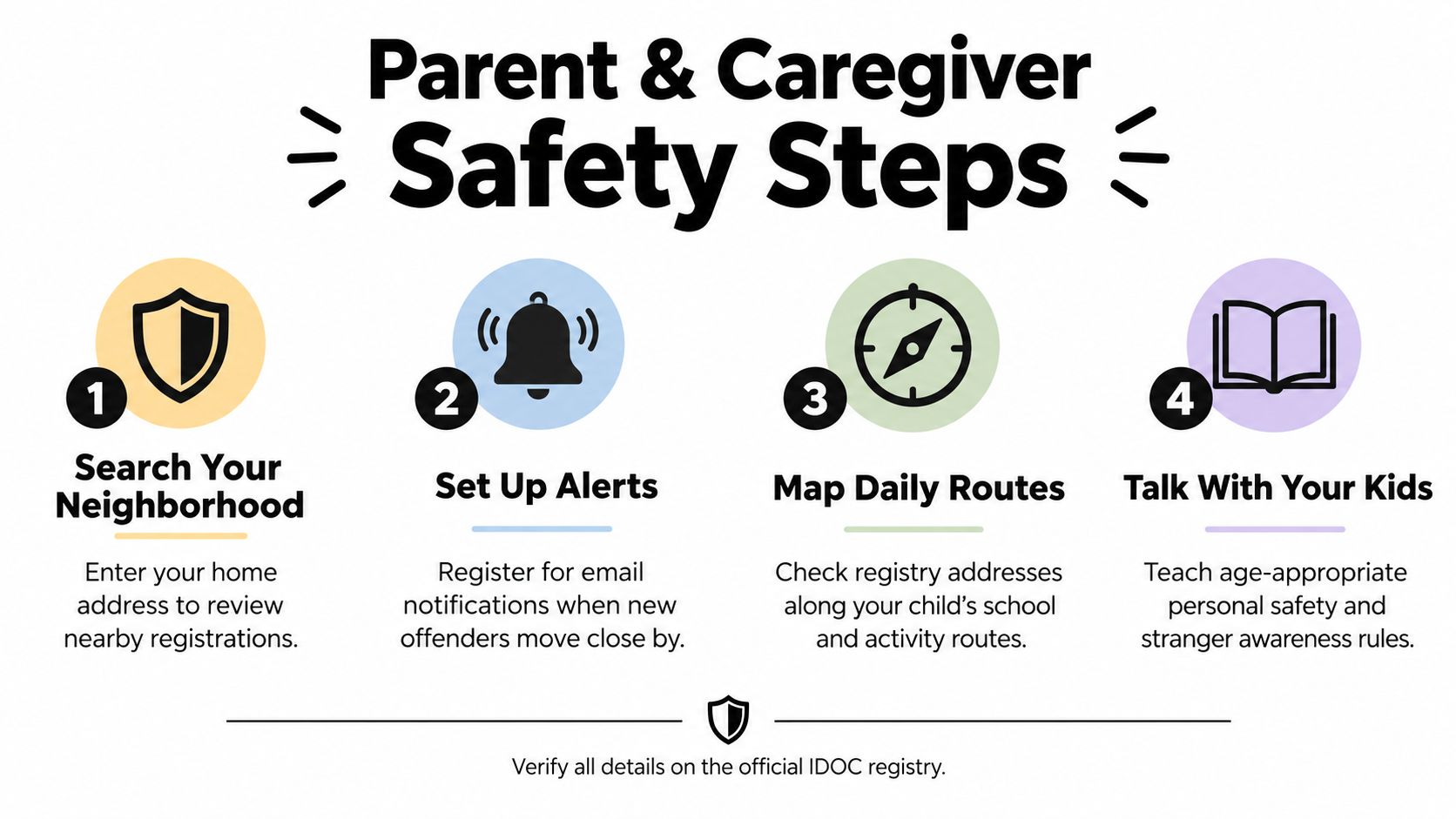
Children need simple, repeatable guidance more than a frightening list of names. Use the registry as one input alongside supervision, safe-pickup plans, trusted-adult networks, and regular conversations about consent and personal space.
Considerations for Real Estate and Landlord Use
A registry search can be relevant to a homebuyer assessing a neighborhood or a landlord reviewing location-specific information. It shouldn't become a shortcut for making a blanket housing decision. Use the official registry to provide factual information, document the date of the search, and consult qualified counsel about federal, state, and local fair-housing obligations before applying a policy.
For a property search, check the address and nearby geography through the official tool. Explain to a prospective buyer or tenant what the registry does and doesn't show. Don't promise that a property is free of risk, and don't present a listing as proof that a person is currently at an address.
Landlords should separate legitimate screening criteria from public stigma. A registry entry may trigger legal questions, but an automatic exclusion policy can create discrimination and due-process concerns. The correct response depends on the property, the applicant, the governing law, and the facts of the situation. A real-estate professional should obtain legal advice rather than improvising a rule.
Keep records limited and secure. Don't circulate screenshots containing unnecessary personal information, and don't use registry data to pressure an applicant, tenant, seller, or neighbor. The practical standard is consistency: use the same documented process for comparable applicants and make decisions based on lawful, relevant criteria.
Comparing Official and Alternative Resources
The official Indiana registry is the strongest starting point because it is the statewide public system tied to Indiana's registration framework. It offers authoritative records and legal context, but its interface may feel less convenient than a commercial map. It also remains a snapshot that requires careful interpretation.
Resource | Best use | Main limitation |
|---|---|---|
Indiana Sex and Violent Offender Registry | Reviewing official registration records and status information | Data must be read with its access date and reporting limits |
Local law enforcement | Reporting suspected inaccuracies or immediate safety concerns | May not provide the same statewide search interface |
Community alerts and newsletters | Learning about local incidents or public-safety announcements | Usually selective, time-sensitive, and not a registry substitute |
Third-party websites | Convenient maps or search interfaces | May lag behind official updates or simplify legal categories |
A third-party site can help you visualize an area, but convenience doesn't make it authoritative. Commercial services may reproduce old information, omit disclaimers, or merge categories that Indiana law treats differently. Use them, if at all, as navigation aids and verify important details against the official registry.
Local police alerts may add context about an incident, but they're not designed to replace the statewide database. For urgent danger, contact law enforcement directly rather than waiting for a registry update or relying on a neighborhood post.
Quick Reference Checklist for Responsible Use
Start with IDOC: Use Indiana's official Sex and Violent Offender Registry for Indianapolis searches.
Choose the right search: Use a name, county, ZIP code, or address-based approach that matches your purpose.
Open the full record: Don't rely on a map marker or reposted screenshot.
Check status and dates: Note compliance information and when you accessed the entry.
Read the category: Registration duration and offense classification affect interpretation.
Respect limits: A listed address isn't proof of a person's exact present location.
Protect privacy: Don't publish unnecessary addresses, vehicle details, or identifying information.
Report concerns properly: Send suspected errors or immediate safety issues to law enforcement.
Avoid confrontation: Never use registry information for harassment, threats, or vigilantism.
Use broader safety habits: Combine registry awareness with supervision, boundaries, and emergency planning.
Conclusion - Balancing Safety and Community
The Indianapolis sex offender list can help residents make informed decisions about homes, routes, parks, and daily routines. Its value depends on careful searching, accurate interpretation, and restraint. I encourage Indianapolis residents to use the official registry as one part of a wider safety plan, while treating every person and family affected by the record with legal and human consideration.
Circle City News™ offers candid Indianapolis reporting and practical guides on sex, crime, local law, and community issues. Visit Circle City News™ for informed local coverage that adds context to difficult subjects without abandoning accountability or compassion.


Comments