Age Verification Policy: A 2026 Compliance Guide
By December 2024, nearly every U.S. state legislature had introduced at least one age-verification bill, and nearly half the states had enacted at least one such proposal, according to the Electronic Frontier Foundation's review of the 2025 policy wave. I've watched age checks move from a niche adult-site concern into something much broader: a new layer of online identity infrastructure that can affect performers, educators, forum users, social-media members, and anyone operating an age-gated feature.
For a Texas cam performer, the question isn't merely whether a viewer is an adult. It's whether a platform, payment processor, verification vendor, or regulator can connect that viewer's identity to lawful sexual expression. For an independent creator in Indiana, a blunt rule can turn a compliance problem into a business interruption. For a user in France returning to an old fan forum, the age check may become the price of access to a community that never previously required identity disclosure.
The public debate often stops at “real ID or AI?” That misses the larger issue. The policy determines when a check is required, what evidence counts, who receives the data, how long it survives, and whether the user can remain anonymous. I'll trace that policy layer first, then examine the laws, the technologies, the privacy trade-offs, and the consequences for adult, indie, and queer creators.
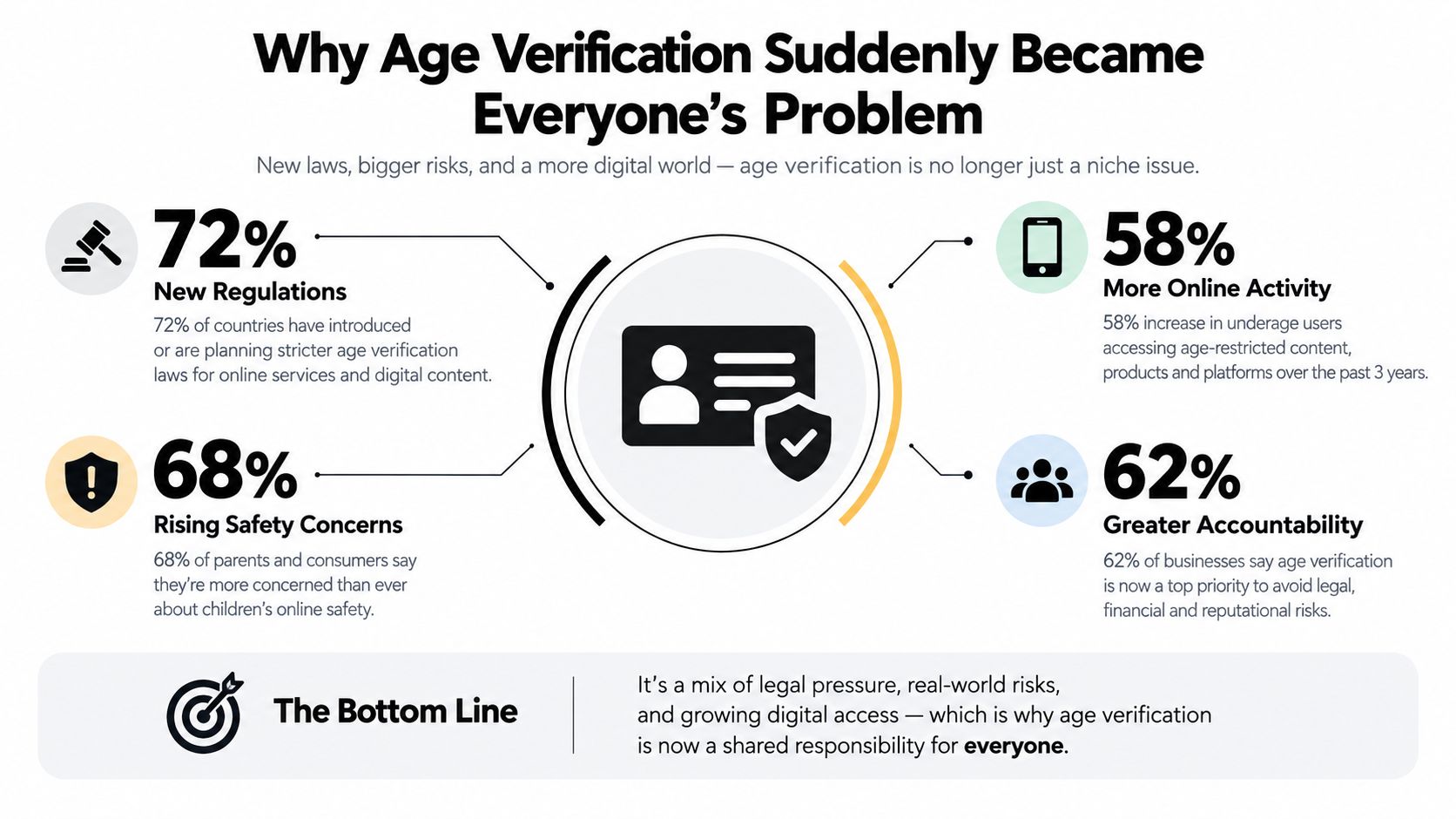
Why Age Verification Suddenly Became Everyone's Problem
Louisiana passed the first modern U.S. state law in 2022, requiring age verification for websites with a “substantial portion” of adult content. A policy tracker now counts 25 states requiring age verification for websites containing material harmful to minors, as summarized by Jumio's overview of age-verification laws. The change marks a sharp break from a system built largely around a birthdate box and an honor-system click.
The rules now reach beyond adult websites. A Congressional Research Service summary describes Australia's restriction on individuals under 16 using certain social-media platforms, with the law taking effect before March 2026. The same summary notes that, by June 2025, 19 U.S. states mandated age verification for adult content and 12 required it for social-media use. Those figures do not establish one national standard. They show a patchwork that pressures platforms to build identity checks even when adult content is not their primary business.
The people inside the policy
A creator encounters a statute as a blocked broadcast, delayed payout, rejected account, or new vendor request for documentation. A viewer may face the same pressure before entering a site, joining a community, or opening lawful material that is politically or personally sensitive.
Lawmakers see age verification as a gate against minors accessing harmful material. Users see a demand for proof that can expose identity, browsing destinations, or intimate interests. Both concerns are real. A compliance banner does not resolve the conflict.
The larger transformation: age verification is becoming a reusable identity function, not a specialty feature reserved for pornographic websites.
The public debate often narrows to “real ID or AI?” The more consequential questions concern when a check is required, what evidence counts, who receives the data, how long it survives, and whether the user can remain anonymous. A narrowly scoped, privacy-preserving proof of adulthood differs sharply from a publisher collecting identity documents itself.
That distinction matters for independent and queer creators, whose audiences may depend on pseudonyms, small communities, or lawful sexual expression. It also matters for anyone whose access to speech, education, or association could become conditional on handing an identity provider evidence of adulthood. Age verification is becoming general online identity infrastructure. The policy choices made now will determine whether that infrastructure limits specific risks or makes private participation the cost of being heard.
What an Age Verification Policy Actually Is
An age verification policy is the rule set a platform uses to determine whether a user meets a minimum age before granting access to specified content, products, or features. The policy answers the governance questions. The underlying technology answers the operational ones.
The simplest analogy is a bar. The house policy says nobody under the legal drinking age enters. The bartender's method might be a driver's license, a passport, a third-party digital credential, facial age estimation, or a less reliable visual judgment. The rule and the checking mechanism aren't interchangeable. A platform can adopt a strict policy while choosing a privacy-preserving verifier, or it can write a vague policy and collect far more information than the situation requires.
Four terms that are often blurred
Age gating usually means asking a user to declare an age or select a birthdate. It creates a barrier, but it may not independently establish that the person meets the threshold.
Age verification seeks stronger evidence that the user is above a specified age, often through a document, biometric signal, payment method, or credential.
Age estimation makes an inference from a face, voice, behavior, or account signals. It produces an assessment rather than a direct documentary proof.
KYC, or know-your-customer, is a broader identity process used to establish who a customer is. An age check should not automatically become full identity verification.
The distinction matters because a platform may need only a binary answer, such as “over the applicable age,” rather than a name, address, document number, or exact birthdate. The European Commission's Age Verification Manual describes a privacy-preserving architecture that uses proof-of-age attestations and interoperable digital-credential standards. Its design can reduce the verified payload to a binary or minimal-age claim instead of sending raw identity documents to every site.
Policy, technology, and law
A platform policy is internal. The company decides which features are restricted, what evidence it accepts, and how it handles failed checks. A law is external. It can require a covered service to verify users, define which content triggers the obligation, prescribe safeguards, or impose penalties.
Terms of service operate at a different level again. They govern the general relationship between a platform and its users, including prohibited conduct and account rules. An age-verification policy may sit inside those terms, but it has a narrower job: to establish eligibility for a specific age-restricted experience.
That separation gives users a practical question to ask: Is this service demanding proof because the law requires it, because the platform chose a cautious design, or because it wants additional identity data? Those explanations lead to different expectations about necessity, retention, and appeal rights.
The Legal Framework from Indiana to the EU
In the United States, age-verification rules have spread through state legislatures rather than a single federal system. Louisiana's 2022 law helped start the current wave, while later measures adopted different definitions, covered services, enforcement models, and positions on social media. An EFF policy review describes broad legislative activity by December 2024, with many states considering or adopting related measures.
Texas shows why statutory thresholds matter. H.B. 1181 treats a site as covered when more than one-third of a site or service's total content being adult or age-restricted qualifies as a substantial portion. It requires commercially reasonable age verification for minors seeking access. A general-purpose service hosting a limited amount of explicit user material can therefore face a classification dispute, particularly when lawmakers, regulators, and courts apply the threshold differently.
Louisiana and Texas have supplied models that other states can adapt, but their approaches do not form one national rule. Indiana, Utah, and other states have pursued separate measures aimed at protecting minors. Lawsuits have raised a competing concern, whether verification mandates burden lawful adult speech or create privacy risks. Readers following Indiana policy can consult Circle City News coverage of prostitution laws by state, while keeping in mind that prostitution law and online age verification address different legal questions.
Jurisdiction | Law / Bill | Scope | Status |
|---|---|---|---|
Louisiana | Act 440 | Websites with a substantial portion of adult content | Passed in 2022, first modern state law identified in the policy tracker |
Texas | H.B. 1181 | Covered adult-content sites above the substantial-portion threshold | Requires commercially reasonable age verification |
United States | State-level laws and proposals | Adult content, social media, and material harmful to minors | Rapidly expanding, fragmented by state |
United Kingdom | Online Safety Act framework | Pornographic and other regulated content | Age-assurance rules applied to in-scope pornography services in July 2025 |
Australia | Social-media minimum-age law | Certain social-media platforms | Under-16 restriction took effect before March 2026 |
European Union | Digital Services Act and wallet blueprint | Risk-based online safety and interoperable proof of age | Blueprint and member-state implementation work continue |
The international direction
The U.K. has chosen a more prescriptive model. In-scope pornography services must verify that users are 18 or older, with the rules applying from July 2025. Noncompliance can trigger the greater of £18 million or 10% of qualifying worldwide revenue, according to Shufti Pro's compliance guide.
France has pursued a privacy-focused design within its adult-content rules. Its 2024 system requires a “double anonymity” method. The platform should not know the user's identity, while the verifier should not know the exact site being accessed, according to Facephi's country overview. That division shows how a legal mandate can separate proof of age from a user's broader identity and browsing destination.
The EU is developing a wider identity framework, not merely a rule for pornography sites. Its proposed architecture supports credentials presented through systems including the W3C Digital Credentials API and OpenID4VP, alongside mobile-driving-licence and digital-document schemas, as described in the European Commission manual. That direction could make age proof part of general online identity infrastructure. It may reduce repeated document sharing, yet it also gives governments, platforms, and credential providers a larger role in everyday access decisions.
Australia's direct social-media restriction, the U.K.’s adult-content regime, and the EU wallet model therefore raise different questions about speech, privacy, and control. For creators and platforms serving users across borders, the fragmentation creates compliance costs. The broader issue is whether a narrow protection for minors becomes a reusable identity gate for many lawful online activities.
How the Major Age Verification Methods Actually Work
The technology choice is a trust decision. Each method determines what leaves the user's device, which party sees it, and how much uncertainty the platform accepts.
Direct document upload
A user photographs a driver's license or passport, then may complete a liveness step to show that the person presenting the document is real and present. The platform or its contractor can receive highly identifying information, including a name, photograph, document details, and birthdate.
This method offers a familiar form of evidence, but it creates the clearest retention risk. If the publisher stores the scan, a breach can connect identity to an intimate browsing context. Even when a vendor handles the process, users need to know whether the publisher receives only an age result or also receives identifying metadata.
Third-party verification
An independent verifier acts as an intermediary. The user submits evidence to that verifier, and the platform receives a result such as an age band or an over-threshold response. France's regulator, the CNIL, recommends that websites not verify age themselves and instead rely on an independent verifier controlled by the user, as explained in its guidance on privacy and protection of minors.
The privacy benefit depends on separation. The verifier shouldn't learn the exact destination, and the platform shouldn't receive unnecessary identity data. The friction comes from leaving the site, choosing a verification method, and trusting an unfamiliar company with sensitive evidence.
Facial or behavioral age estimation
Age estimation uses a face, voice, or account-level signal to infer whether someone likely meets a threshold. A system may ask for a selfie, analyze it on a server, or, in a more privacy-protective design, process the image on the device and return only an outcome.
This can be faster than document upload, but it can misclassify users and raise questions about bias, accessibility, biometric handling, and appeal. Behavioral signals also deserve scrutiny because an account's history, payment information, community memberships, or usage patterns can reveal more about a person than a simple age response.
Digital identity wallets
A wallet stores a credential issued or attested by a trusted authority. The user presents a proof rather than repeatedly uploading an identity document. The European Commission's blueprint uses ISO mDoc and related standards, with presentation through digital-credential and verification protocols, to support a minimal-age claim across services.
Method | What User Shares | Data Retention Risk | Friction Level | Accuracy |
|---|---|---|---|---|
Direct ID upload | Document image and identity details | High if publisher or vendor retains scans | High | Strong documentary evidence, subject to fraud and matching errors |
Third-party verifier | Evidence sent to an intermediary, result returned to platform | Lower when data separation and deletion work as designed | Moderate to high | Depends on method and vendor controls |
Facial or behavioral estimation | Face, voice, or account signals | Varies sharply by on-device processing and retention | Low to moderate | Inference can produce false decisions |
Digital identity wallet | Minimal-age credential or attestation | Lower exposure when only the required claim is disclosed | Moderate during setup, lower for repeat use | Depends on issuing authority and credential integrity |
No method is frictionless and private by default. The meaningful question is whether the system proves the minimum necessary fact while keeping the publisher from assembling a permanent identity record.
The Privacy and Safety Trade-Offs Nobody Wants to Talk About
The strongest age check isn't automatically the safest system. A document upload may make it harder for a minor to access restricted material, but it can also create a database linking a real person to a sensitive activity. That risk falls especially heavily on adults whose identity, sexuality, health questions, or political interests could expose them to stigma, harassment, employment consequences, or family danger.
The CNIL's guidance treats independent verification as a way to reduce the information a website receives. The FTC's 2026 COPPA policy statement makes the limits more explicit: age-verification data should be used only to determine age, retained only as long as necessary, protected with reasonable safeguards, and shared only with vetted third parties.
A database can become a liability
Every additional party in the flow creates another governance question. Who can access the document? Can the vendor reuse it for model training or marketing? Does the platform receive a unique identifier that can be matched across sessions? Can a user appeal a failed result without submitting more sensitive material?
The practical danger: a system designed to keep minors away can expose adults to identification, profiling, or retaliation.
Privacy also protects speech. Anonymous access lets people research sexual health, explore identity, read about abuse, and participate in communities without immediately attaching a legal name. LGBTQ+ users, sex workers, and survivors may have especially strong reasons to avoid a permanent verification trail. Requiring proof of identity before reading or posting can make lawful participation feel too risky, even when the platform never intended to police speech.
That is why the debate can't be reduced to whether someone supports child safety. The core question is whether a specific design lowers harm for minors without creating a larger hazard for adults. Readers interested in the broader argument over state power, data access, and privacy can also review Circle City News commentary on Apple's fight with the FBI, a related debate rather than a source on age-verification law itself.
Who pays when policy ignores the trade-off
Large platforms can hire counsel, negotiate vendor contracts, and build multiple verification paths. Small publishers and independent creators often can't. Users pay through lost anonymity, creators pay through reduced access and increased compliance exposure, and marginalized communities pay when private participation disappears.
Safety measures can be justified and still be badly designed. A policy that protects one group by forcing another group into an identity database isn't neutral. It moves risk. The people carrying that risk deserve a meaningful say in how the system works.
What Good Age Verification Policy Looks Like
A defensible age-verification policy begins with privacy by design. If an independent verifier can return only an over-threshold result, the publisher has little reason to retain raw identification. FTC guidance supports narrow use, limited retention, reasonable safeguards, and carefully controlled sharing. The EU blueprint shows how a credential can disclose a minimal age claim without exposing a complete identity record.
Four tests for a defensible system
Minimize the answer. Request “adult” or an applicable age band when that satisfies the legal purpose. A full name, exact birthdate, address, or document image should not be collected simply because the system can request them.
Match method to risk. Explicit adult content may warrant a stronger check than a general discussion of relationships, politics, or health. Requiring a selfie with an identity document for low-risk material makes the process disproportionate and can discourage lawful speech.
Separate the parties. An independent verifier should not learn the exact browsing destination, while the publisher should not receive the evidence used to establish age. France's double-anonymity approach provides a concrete model for keeping those facts apart.
Make vendors accountable. Regulators should audit verification providers, examine deletion practices, test security controls, and require meaningful remedies for false denials. A compliance badge does not replace independent oversight.
Platforms should explain the method before requesting sensitive data. Their notices should identify whether processing occurs on the device or a server, name the verifier, describe retention, and provide an appeal route. Declining access to age-restricted material should not make unrelated account functions unusable.
A policy is credible only when users can understand it, challenge it, and leave with less data exposed than the service actually needed.
A short checklist can expose weak safeguards:
Necessity: Is the check limited to a restricted feature?
Minimization: Does the service receive only an age result?
Independence: Does a separate verifier handle identity evidence?
Deletion: Is the retention period clear and enforceable?
Choice: Are there multiple accessible methods and an appeal process?
Oversight: Can a regulator inspect the vendor rather than accept its assurances?
The technical model shapes the risk. Wallet credentials and on-device estimation may reduce repeated disclosures, but they still need governance, testing, and transparent rules. Users also need a clear answer about who can reconstruct their activity, because an age check can become part of broader online identity infrastructure rather than a one-time barrier.
The Impact on Adult Indie and Queer Creators
Creators expose the practical costs of age-verification laws. A large platform may absorb a new compliance workflow, while an independent performer or queer educator often relies on several fragile relationships at once: a hosting service, payment processor, fan platform, clip store, and audience that values privacy.
That creator may produce legal explicit work, erotic fiction, kink-adjacent education, or trans and lesbian performance. A blunt classification system can group those activities with high-risk commercial pornography, even when the work is educational, artistic, or community-focused. Visibility may fall, an account may enter review, payments may stop, or a service may remove the account without a clear explanation.
The public record does not support a success story for the compliance industry. It does show a structural imbalance. Platforms can impose one verification requirement on thousands of creators, while each creator has limited ability to challenge a vendor's error or a payment processor's decision.
Anonymity is part of the business model
Anonymous tipping and pseudonymous participation are business safeguards for many creators. They let viewers support work without disclosing intimate interests, while performers maintain boundaries between a public persona and offline identity. Verification logs create another exposure point. Attackers might obtain them, employees might misuse access, or vendors might connect records across services.
The Circle City News discussion of age-verification laws and indie queer porn reflects the political argument around this pressure. Creators are not rejecting child safety. Their concern is whether lawmakers distinguish a major adult platform from a small creator whose audience, income, and personal safety depend on controlled disclosure.
Age verification is also becoming part of broader online identity infrastructure. A check introduced for restricted content can influence how services classify creators, audiences, and lawful sexual expression across multiple platforms.
The people policed most directly
Queer creators face added risk when automated systems misread sexual expression, gender presentation, or educational context. An age gate may appear neutral in law yet operate unevenly if its categories, moderation rules, or appeals process treat marginalized material as suspicious.
Those most directly regulated often have the fewest resources to contest a bad decision. A workable policy must protect minors without requiring adult creators to surrender identity data, accept unexplained bans, or move audiences toward services with less accountability. Until lawmakers examine those outcomes, claims of safety remain incomplete.
Where This Goes Next and What to Watch
The next disputes will test whether age verification remains a narrow content safeguard or becomes general online identity infrastructure. U.S. courts will weigh state statutes against privacy and lawful adult speech. The EU will refine age assurance under its digital-services framework, while its wallet blueprint could influence systems beyond Europe. Reusable credentials may reduce repeated checks, but only when users control disclosure and services request the minimum.
For creators, audiences, and platforms, two questions expose weak policy: Does the check happen on my device or on a server? What happens to my verification data after the session ends? Clear answers matter more than technical branding, especially for indie and queer creators whose livelihoods and expression can depend on limited disclosure.
By: Jill Hills
Circle City News™ reports on sex, crime, law, consent culture, and the adult entertainment industry through Circle City News™, including age-verification policy and creator rights.

Comments