Sex Worker Advocacy: A Practical Guide to the Movement

The most popular advice about sex worker advocacy is to “listen to sex workers.” That's necessary, but it isn't enough. Listening without changing who controls money, policing, healthcare, platforms, and policy can turn lived experience into decoration.
I've spent time reporting around Indianapolis, where the distance between what the law says and what people can safely do is often the central fact. A person may have a legal right to seek medical care, yet avoid a clinic because disclosure could bring stigma. A victim may be eligible for help, yet choose not to call police because the same system has treated survival as evidence of wrongdoing. Sex worker advocacy is therefore not one argument about decriminalization. It's a practical fight over labor protections, safety, healthcare access, police accountability, privacy, and durable funding.
Why This Work Matters Right Now
Sex worker advocacy is often framed as a single dispute over decriminalization. In Indianapolis, the practical questions are broader: who can work without increased danger, who can reach healthcare, how police respond to violence, and whether funding supports long-term services rather than enforcement.
On a Monday night near the city's near-east side, a volunteer organizer sorts safer-use supplies, condoms, and phone chargers across a folding table. A street-based worker waits until the room thins before asking whether the new IMPD overtime unit is still parked on her corner. The question is quiet, but its implications are concrete. Enforcement can change where people work, how they travel, whom they trust, and whether they seek help after violence.
Indiana prosecutors continue to charge prostitution under IC 35-45-4-2, while FOSTA-SESTA continues to shape online communication and advertising. Indianapolis organizers also work amid local violence concerns, federal trafficking investigations, and disputes over how anti-trafficking money should be spent. Without direct documentation for specific local reports or federal budget figures, those claims require verification. The broader concern remains clear: services, accountability, and funding can be treated as secondary when enforcement receives the quickest institutional response.
National evidence gives the debate a wider frame. Later health reviews associate criminalization with violence, weaker condom negotiation, and reduced access to services. Research reviewed by the Journal of Sex Research reports better workplace conditions and stronger engagement with care in decriminalized settings, while leaving room for disagreement about how findings apply across jurisdictions.
Local organizers describe the issue in similarly practical terms. This Indianapolis perspective on International Sex Workers' Day offers a starting point for understanding how national arguments meet the city's own organizing realities.
The sections ahead examine movement history, policy models, Indiana law, health evidence, violence reporting, and the funding gap, then consider ways to support the work without turning solidarity into rescue.
What Sex Worker Advocacy Actually Means
Sex worker advocacy is collective organizing to improve safety, health, autonomy, and working conditions for people who exchange sexual services for income. Current and former sex workers often lead that organizing, alongside harm-reduction workers, legal-aid lawyers, public-health researchers, and informed allies. The distinction matters because outside groups can provide resources without claiming authority over people whose lives they don't share.
A labor-rights lens starts with concrete questions:
Who can work safely? Advocates commonly support removing criminal penalties for consensual adult exchange, including laws that push people into isolated locations or make screening clients more difficult.
Who can get care? Housing providers, clinics, and public agencies should not use a person's work status as a pretext for denial, harassment, or unnecessary disclosure.
Who answers for coercion? Trafficking victims need protection and services, while employers, managers, and abusers who use force, fraud, or coercion need accountability. Treating every sex worker as a trafficking victim can erase the people who are trying to define their own needs.
Who writes the rules? Meaningful participation means more than a public listening session. Sex workers need influence over legislation, agency guidance, funding decisions, and safety protocols.
Different movements, overlapping needs
The trafficking-survival movement and sex worker rights movement aren't identical, even when people use similar language. Survivors may prioritize prosecution, exit services, and recognition of coercion. Decriminalization-aligned advocates may prioritize labor rights, privacy, police accountability, and the ability to report violence without self-incrimination. Some people hold both positions because their experiences have changed over time.
Groups such as SWOP-USA, Decrim NY, HIPS, and the Indiana Recovery Alliance illustrate different forms of community-centered work, from organizing and legal reform to harm reduction and direct support. Their approaches aren't interchangeable, and no organization should imply that one spokesperson represents everyone.
Indiana's IC 35-45-4-3, often used in arguments about loitering and public-order enforcement, belongs in this conversation because laws that appear neutral can have unequal effects. The practical test is simple: does a rule reduce coercion and violence, or does it make workers less visible, less able to screen clients, and less willing to seek help?
The History of the Movement
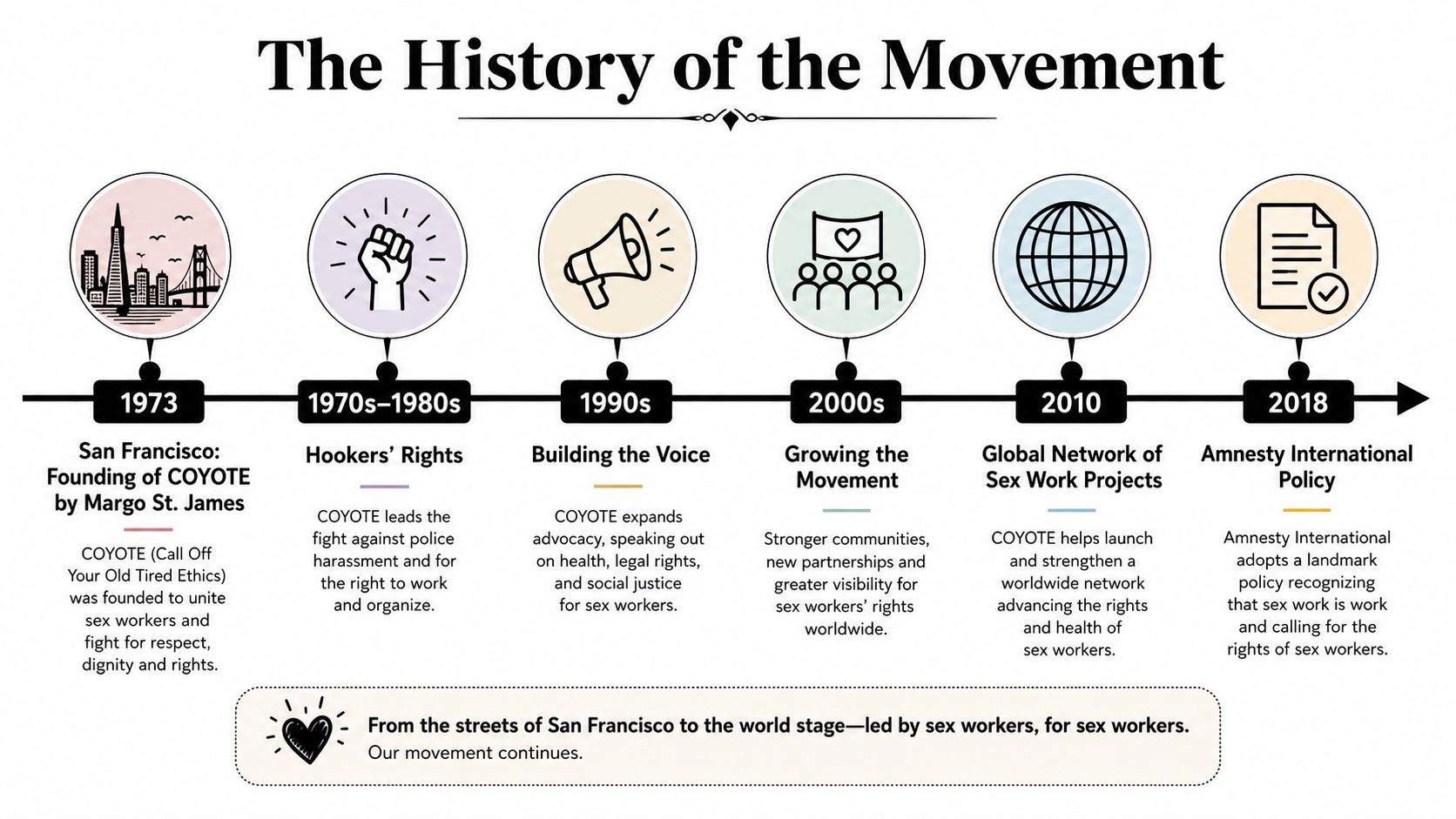
The modern movement began with organizing, long before governments offered reform packages. In the United States, COYOTE was founded in 1973, commonly associated with Margo St. James and San Francisco's hookers' rights movement. Its name, “Call Off Your Old Tired Ethics,” challenged the idea that outsiders should set the moral terms of sex workers' lives.
That year also brought public arguments about sexual oppression, labor, and autonomy. Organizers linked sex-worker rights to wider feminist debates, while COYOTE's “Principles of Sexuality” centered consent and personal freedom. The movement never spoke with one voice. Disputes over exploitation, agency, and the role of the state have remained part of its history.
In 1975, more than 100 sex workers occupied a church in Lyon, France, protesting police harassment, poverty, and stigmatizing treatment. The action became a landmark because it presented sex work as a labor-rights issue, not only a moral or criminal one. That framing helped establish the principle that sex worker rights are human rights, as described in the Harvard Law Review account.
From rights charters to health organizing
During the 1970s, sex workers also pursued union-style organization through efforts such as the National Association of Legitimately Working Girls. The feminist “sex wars” of the 1980s sharpened disagreements over pornography, prostitution, exploitation, and agency. The Dworkin-MacKinnon ordinances advanced one anti-pornography approach, while feminist-led counter-mobilization defended speech, autonomy, and sex-worker participation in policymaking.
The World Charter for Prostitutes' Rights, drafted in 1985 at the First World Whores' Congress in Amsterdam, marked an institutional shift. Later networks carried those principles across borders. The Global Network of Sex Work Projects was founded in 1990, and the Front Line Defenders report describes a movement involving defenders and community members in countries around the world.
Harm reduction gained importance as HIV policy exposed the health costs of criminalization. Sex-worker-led groups later contributed to international guidance, including the 2013 UNAIDS guidance and the 2014 Durban Declaration. After FOSTA-SESTA, digital safety and access to online platforms became central concerns. The 2022 U.S. National Sex Worker Bill of Rights offered organizers a shared rights-based reference point.
In Indianapolis and elsewhere in Indiana, the history remains connected to present work on harm reduction, safety planning, healthcare access, police accountability, and local policy. Organizers may disagree about legal models, yet those disagreements reflect different assessments of how rules affect workers in practice, not a single dispute over morality.
The Four Policy Models Explained
Policy labels can conceal who bears the risk. I compare the four main models using the same questions: who is criminalized, what labor rights exist, how trafficking is addressed, whether people can reach health services, and what evidence says about conditions in practice.
Model | Who Gets Criminalized | Labor Rights | Trafficking Response | Public Health Access | Real-World Example |
|---|---|---|---|---|---|
Full criminalization | Sex workers, buyers, and often third parties | Usually weak or absent | Relies heavily on policing, which can blur consensual work and coercion | Criminalization can discourage care and condom negotiation | United States jurisdictions, including Indiana |
Nordic or neo-abolitionist | Buyers and some third parties, with sex workers often formally exempt | Limited, because the market remains constrained | Targets buyers and treats demand as the central problem | Advocates describe protection, while critics report displacement and reduced trust | Sweden |
Legalization and regulated licensing | Unlicensed workers, buyers in prohibited settings, or businesses outside the rules | Rights may exist inside licensed systems | Uses licensing and inspection alongside criminal law | Access can improve for people inside the regulated sector, while others remain exposed | Germany and regulated Australian jurisdictions |
Full decriminalization | Consensual adult exchange is removed from criminal law, while coercion remains illegal | Opens space for ordinary labor and workplace protections | Investigates force, fraud, and coercion without treating consensual work as the crime | Evidence from New Zealand and New South Wales links reform with better service engagement | New Zealand and New South Wales |
The Nordic model appeals to people who believe buyers should carry the legal burden and that reducing visible demand can reduce exploitation. Critics, including sex-worker organizers, argue that buyers may move to more isolated settings, making screening harder and increasing violence risk. The dispute isn't theoretical. It concerns whether a worker can negotiate location, price, condom use, and emergency support under pressure.
Legalization offers a different bargain. A licensed venue may provide clearer rules and inspections, but people who can't qualify, don't want to register, or work outside the approved structure may remain criminalized. That split can create a two-tier system where the safest protections are available only to a narrow group.
Full decriminalization doesn't eliminate abuse. It changes which conduct receives criminal attention. Amnesty International defines decriminalization as removing laws and policies that make sex work a criminal offense, including measures targeting workers, buyers, solicitation, and the general organization of sex work, as explained in its sex-work-rights guidance.
For a state-by-state overview, consult this guide to prostitution laws, then read the statutes rather than relying on labels.
U.S. Policy and Indiana Law Right Now
The United States has no federal decriminalization framework for consensual adult sex work. Instead, people encounter overlapping state criminal laws, federal trafficking tools, immigration consequences, online restrictions, and platform policies. FOSTA-SESTA narrowed legal protections for online services in the sex-work context, while the Mann Act remains part of the federal framework governing interstate transportation for prostitution or criminal sexual activity.
The EARN IT Act has also cast a shadow over digital safety conversations, particularly for groups worried that expanded platform responsibility could increase surveillance or remove lawful harm-reduction information. That concern sits beside a broader political environment in which sex-related commerce is often treated as a policing problem before it's treated as a labor or public-health issue.
Indiana's core statutes are found in IC 35-45-4 and IC 35-45-5. In practical terms, prosecutors can charge prostitution, patronizing a prostitute, and related conduct involving solicitation or commercial sexual activity. Public-order provisions, including IC 35-45-4-3, may also affect where people can stand, communicate, or work.
The collateral consequences are part of the punishment
A conviction can affect more than the immediate case. Depending on the offense and circumstances, people may face registration consequences, driver's-license suspension under IC 9-30-16, employment barriers, housing problems, and complications when seeking expungement. Existing prostitution convictions can make legal cleanup difficult, particularly for people who lack money for counsel or who have other records.
Indianapolis enforcement can involve the IMPD Vice Unit, while federal agencies and statewide human-trafficking task forces pursue cases involving coercion and exploitation. Those missions can overlap, but they aren't the same. A trafficking investigation should identify force, fraud, or coercion. A vice operation may instead focus on proving a prohibited commercial exchange.
That difference matters to outreach workers. If a person believes a harm-reduction conversation could expose them to arrest, they may avoid the very service that could help them report violence, obtain testing, or find housing. Readers seeking legal information can start with this Indianapolis guide to Indiana sex laws, then contact a qualified Indiana attorney or legal-aid provider for advice about a specific case.
Health and Safety Evidence From Decriminalization
The strongest argument for decriminalization isn't that every legal reform automatically produces safety. It's that criminal penalties can interfere with the conditions that make safety possible: screening, negotiation, healthcare access, stable workplaces, and cooperation after violence.
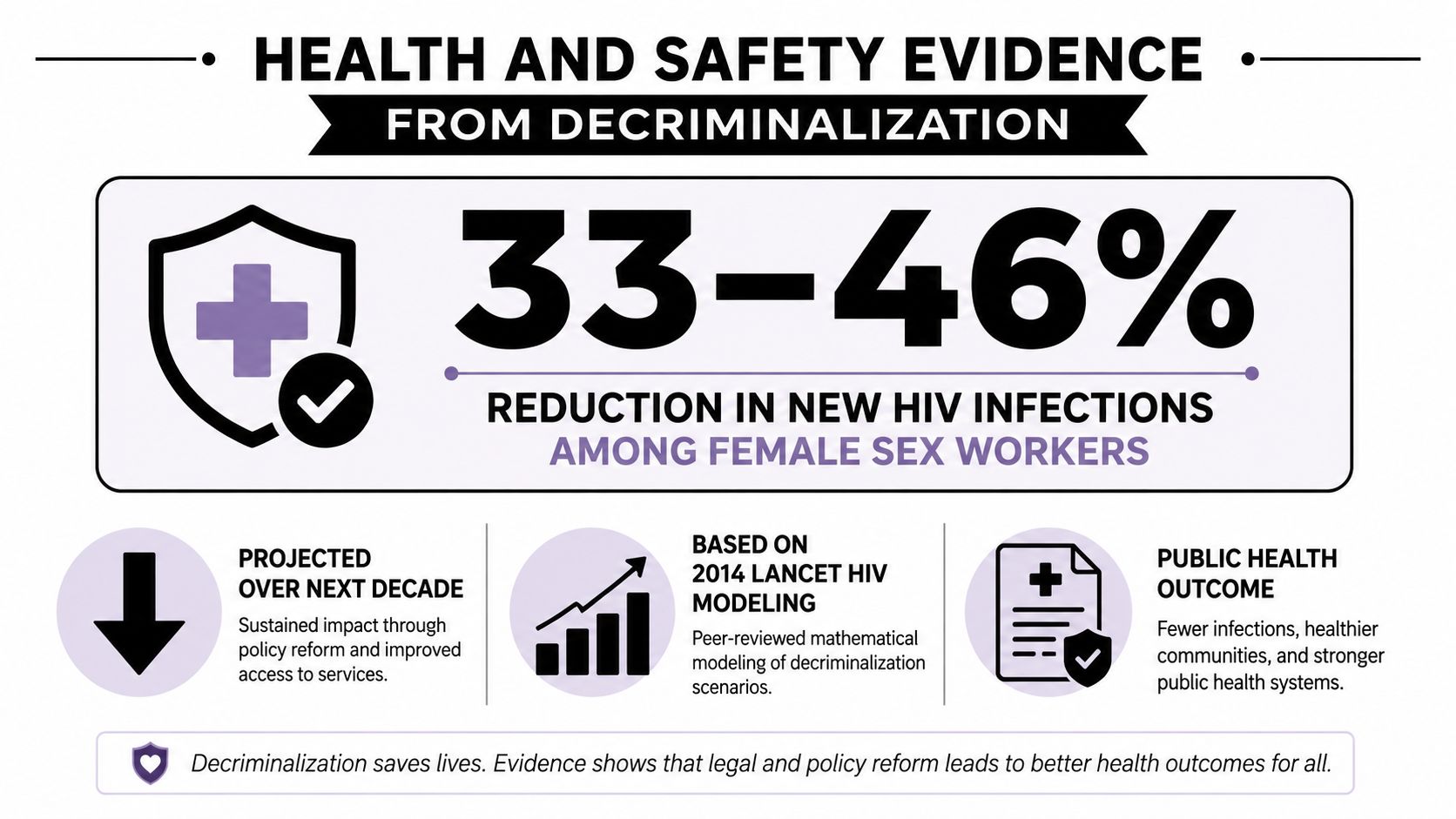
A landmark synthesis using mathematical modeling projected that full decriminalization could avert 33–46% of new HIV infections among sex workers and their clients over a decade. The same research connected reform with reductions in client violence and condomless sex. Those figures are projections, not a record of infections prevented in one city, and the distinction matters. The underlying source is the Lancet HIV modeling and review evidence.
What the jurisdictional evidence can and can't show
Reviews of New Zealand and New South Wales associate decriminalization with better workplace safety, greater use of health services, and improved sexual-health testing. The comparison isn't a clean laboratory experiment. Laws operate alongside housing conditions, healthcare systems, migration rules, policing practices, and local organizing.
New Zealand is often discussed because its framework moved consensual adult sex work out of criminal law while retaining offenses against coercion and abuse. The practical question is whether people can use the resulting space to negotiate safety and reach services. Evidence summarized in the cross-jurisdiction review points toward stronger care engagement, but it doesn't prove that every worker benefits equally.
The data is thinner for transgender and male sex workers, and methodological debates remain over sampling, underreporting, and how researchers define decriminalization. That limitation shouldn't erase the available evidence. It should shape the next research questions and reinforce the need for sex-worker-led data collection.
Here's the public-health test I use: does enforcement make it easier or harder to carry condoms, seek testing, disclose violence, and ask for help? A policy that claims to protect people should be judged by those everyday outcomes, not only by the number of arrests or prosecutions.
The following video offers another public-facing way to discuss the health evidence:
Violence, Reporting, and the Funding Gap
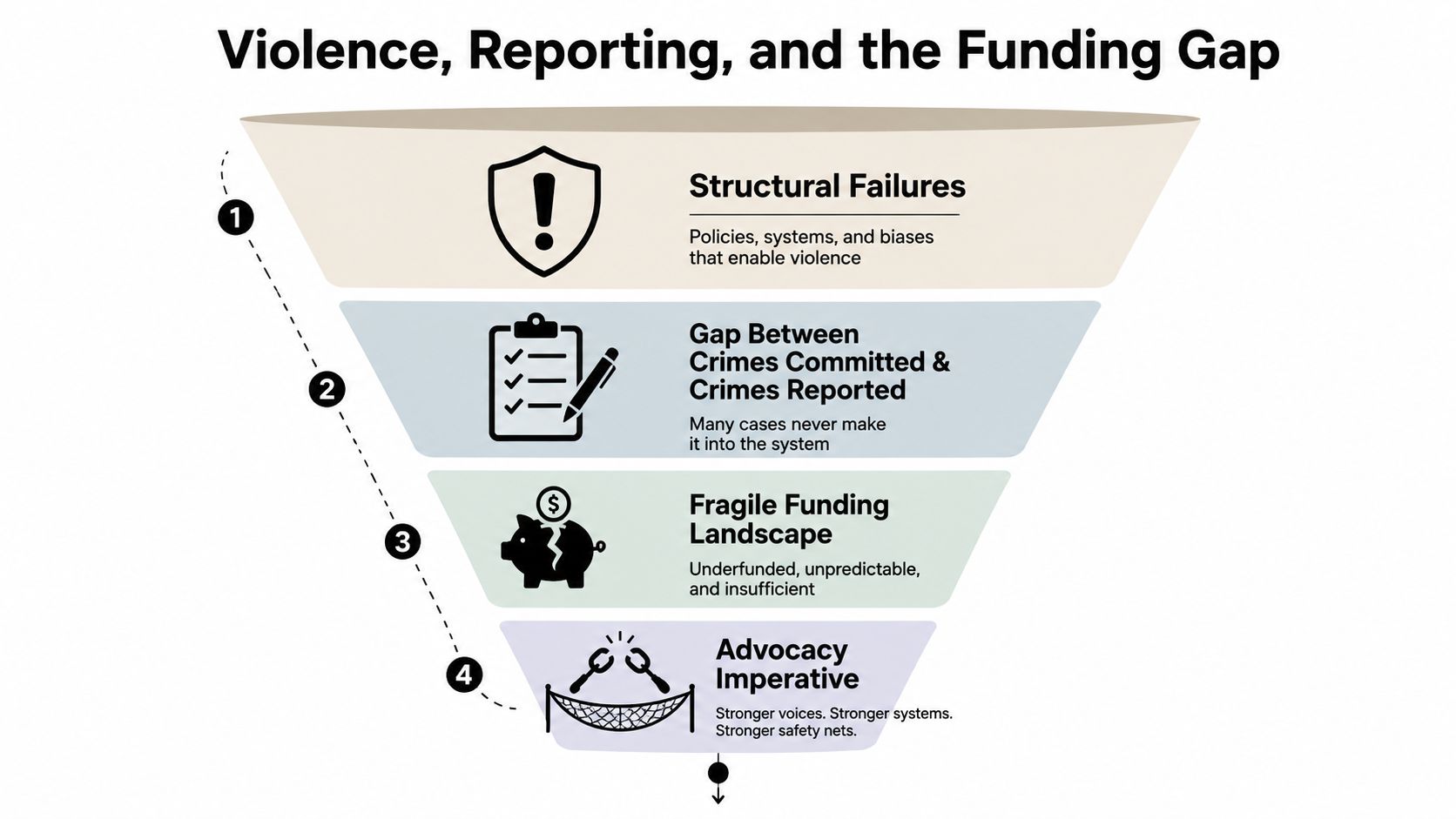
A crime can be real without entering a police database. That gap is especially important for sex workers who fear arrest, outing, retaliation, disbelief, or the loss of housing and income after reporting. In the United Kingdom, National Ugly Mugs processed 756 reports of violence in 2024 and supported 1,279 sex workers, yet only 8% of 1,047 violence reports were shared with police, according to its 2025 signed accounts.
Those numbers don't measure every violent incident, and they come from one reporting organization. They do show why “just call the police” is an incomplete safety plan. Alternative reporting systems can help people preserve evidence, warn others, and choose whether formal law enforcement becomes involved.
Three failures reinforce one another
The reporting problem is tied to money. Harm-reduction programs often depend on short grants, while people seeking help may need housing, healthcare, legal support, transportation, childcare, and safety planning at the same time. A single agency rarely has the authority or funding to handle that whole bundle.
A durable model would fund all three pieces together:
Trusted reporting pathways: Bad-date systems and community responders should preserve choice, protect identifying information, and create routes into formal investigations when survivors want them.
Stable community funding: Sex-worker-led groups need funding that doesn't disappear when a grant cycle closes or an outside donor changes priorities.
Wraparound care: Housing, health services, legal aid, and crisis support should coordinate without forcing people to repeatedly disclose stigmatized information.
Police partnerships can improve evidence collection in some cases, but they can also weaken trust if agencies treat outreach as intelligence gathering. Community accountability models may offer more control to survivors, yet they can lack investigative power. The evidence is thinner on which combinations work best in different Indiana communities, so advocates should measure outcomes rather than presenting one structure as universally safe.
How to Support the Movement Responsibly
Support starts with following the lead of sex-worker-led organizations, not with creating a rescue project around people who never asked for one. Before donating or volunteering, find out who sits on the board, who controls the budget, whether current or former sex workers hold decision-making roles, and whether participants can refuse services without punishment.
A practical checklist:
Give directly when possible. Prioritize organizations led by current and former sex workers, including groups working on harm reduction, legal defense, safety alerts, healthcare access, and policy. Large intermediaries may have useful resources, but they shouldn't replace community control.
Support specific Indiana policy work. Ask lawmakers where they stand on decriminalization proposals introduced in the Indiana General Assembly, protections against collateral consequences, police accountability, and funding for survivor services. At the federal level, track the SAFE Act and Sex Worker Decriminalization Act language rather than treating any bill title as proof of its contents.
Protect privacy. Don't name, photograph, tag, record, or identify anyone in the industry without explicit consent. A public event isn't blanket permission to publish a person's face, legal name, workplace, or immigration status.
Reject savior volunteering. Don't arrive with a camera, demand personal stories, or assume that an offer of help gives you access to someone's life. Ask what the organization needs, complete its training, and accept limits.
Don't undermine labor organizing. Buying sex isn't automatically solidarity. Bargaining, privacy, payment, boundaries, and consent still apply, and supporters shouldn't use transactions to pressure workers into advocacy or publicity.
A useful vetting question: Can the organization explain how sex workers influence its decisions, and can it describe what happens when a participant disagrees?
Red flags include groups that exclude sex workers from their own boards, describe all sex workers as helpless, publish identifiable stories without clear consent, or funnel every problem toward police and prosecution. A credible local group should explain its confidentiality practices, referral relationships, funding sources, and limits. It should also acknowledge disagreement between abolitionist and decriminalization-aligned sex workers instead of pretending the movement is politically uniform.
In Indianapolis, immediate priorities are concrete: pass or block specific bills in the Indiana General Assembly, build durable harm-reduction funding outside the grant-cycle cliff, expand bad-date and violence-reporting infrastructure in Indianapolis and smaller Indiana cities, and pressure national platforms to stop deplatforming sex workers and sex-worker-led organizations. Allies can also support legal information and privacy education. Circle City News™ publishes reporting and guides on sex, crime, adult-industry work, consent culture, and Indiana policy, making it one possible local source to consult alongside legal-aid and community organizations.
An organizer I spoke with described the need less as applause than as consistency: show up when a bill is moving, keep funding stable after the news cycle ends, and don't demand a personal story to prove that harm happened. That's a realistic standard for the next two to three years. Progress may look like safer reporting routes, fewer punitive encounters, more reliable healthcare access, stronger worker control, and laws that distinguish coercion from consensual adult work. It won't resolve every disagreement, but it can make survival less dependent on silence.
Circle City News™ offers Indianapolis-focused reporting on sex, crime, adult-industry work, consent culture, and the laws shaping real lives. Visit Circle City News™ for candid local coverage and practical context on sex worker advocacy, Indiana policy, and community safety.


Comments