Can You Make Money Selling Feet Pics? A Guide to the Niche Economy

Let's get straight to the point. My name is Jill Hills, and as your guide to the creator economy, I'm here to tell you the answer is a resounding yes. You absolutely can make money selling feet pics, and it's a far more structured and viable market than most people think. This isn't some internet myth; it's a real side hustle, complete with dedicated platforms and a surprisingly large, active audience.
Your Guide to Selling Feet Pics

If you're reading this, you’re probably curious about the buzz around selling photos of feet online. Maybe you stumbled across a viral story or heard whispers of creators earning serious cash from what sounds like a simple gig. My job is to give you the honest, no-fluff breakdown of this niche corner of the economy.
I like to think of what follows as the executive summary for the whole venture. I'm here to give you a clear snapshot of what it really takes to succeed, the actual income potential, and the safety rules that are absolutely non-negotiable. This is about more than just snapping a few photos—it's about understanding a specific market and running it like a small business.
What to Expect in This Guide
Before I dive deep into the specific strategies and platforms, let's get a bird's-eye view. This guide will walk you through everything a beginner needs to know, without the hype or judgment. I'll teach you about:
Realistic Income Potential: I'll break down what newcomers can expect to earn compared to what top creators are pulling in. Just last month, one creator I spoke with cleared over $8,700 after platform fees—and that was solely from feet-focused content.
Minimal Startup Costs: The great news? You don’t need a fancy studio. From my experience, a good smartphone camera and some decent natural light are often all it takes to get your foot in the door (pun intended).
Safety and Anonymity: This is my number one priority for you. We’ll cover exactly how to protect your identity, handle payments securely, and establish firm boundaries from day one.
The key to successfully making money selling feet pics isn't just about having nice feet; it's about having a smart business strategy. From what I've seen, it requires creativity, consistency, and a serious commitment to your personal safety.
Let's quickly summarize the key aspects you need to consider before jumping in.
Selling Feet Content At A Glance
This table breaks down the essentials, from potential earnings to the crucial safety protocols you need to follow.
Aspect | Key Details |
|---|---|
Average Earnings | Beginners often earn $50-$200 monthly. Top creators can exceed $5,000 per month. |
Startup Costs | Very low. A smartphone with a good camera and internet access is often all that's needed. |
Time Commitment | Can range from a few hours a week to a full-time effort, depending on your goals. |
Key Platforms | OnlyFans, FeetFinder, Fansly, and social media sites like Instagram or X (formerly Twitter). |
Top Safety Rules | Never show your face, use a pseudonym, use secure payment methods, and never share personal info. |
Legal & Tax | Must be 18+. All earnings are considered taxable income by the IRS and must be reported. |
Ultimately, this is a real business, and I believe you have to treat it that way.
This side hustle is accessible to just about anyone over 18, but your success will hinge entirely on your approach. It’s a legitimate income source, and like any other form of freelance work, it’s considered taxable income by the IRS. Throughout this guide, I'll walk you through the entire process, from taking your first photo to building a sustainable income stream—all while keeping you safe and informed. Let’s get started.
Understanding the Demand for Feet Pics
So, what’s really going on with the fascination with feet? It’s a question that I get a lot, and the answer boils down to a mix of basic market economics and human psychology. The interest in this type of content isn't some fleeting internet trend; it’s grounded in a surprisingly common and well-documented fascination.
This interest, clinically known as podophilia, creates a large and very engaged customer base. For anyone I advise, I tell them this means you’re not just tossing photos out into the digital abyss. You’re tapping into a specific, well-defined audience that's actively looking for what you have to offer.
The Psychology Driving the Market
At its heart, the demand comes from foot fetishism, which happens to be one of the most widespread paraphilias. Psychologists have different theories on the "why," but I understand it often involves the brain creating a powerful, and sometimes exclusive, link between feet and sexual arousal. You can think of it as a highly specialized preference, not unlike how some people are drawn to a certain hair color or accent—just much more intense and focused.
For a lot of buyers, it's about more than just a picture. It's about the fantasy, the personal connection, and the interaction with the person behind the camera. This dynamic means that your personality and authenticity can be just as valuable as the photos themselves. Grasping this helps me explain why the market is so resilient. I explore this topic in much more detail in my deep dive on the foot fetish community and the psychology behind it.
And the numbers definitely back this up. Far from being rare, foot fetishes are the most common fetish among men, making up about 36% to 47% of all sexual fetishes. This has turned what many assume is a tiny niche into a serious opportunity for digital creators. In fact, data I've reviewed shows that roughly 53% of people have at least one sexual fetish, with feet leading the way for body-part specific interests. You can check out more of these sexual fetish statistics on Wifitalents.com.
The key takeaway I always emphasize is simple economics: where there's steady demand, there's an opportunity to supply. The internet has just provided a safe and accessible marketplace for this long-standing interest to flourish.
What Are Buyers Actually Looking For?
If you’re wondering whether you can really make money from this, you have to understand what motivates someone to buy. In my experience, it’s almost never just a generic picture of feet. Buyers are usually looking for a specific look, scenario, or style that speaks to them on a personal level.
Here’s a quick rundown of what I've seen often drives a sale:
Specific Poses and Angles: High arches, shots of the soles, close-ups of toes, and even action shots (like walking or stepping on something) are all popular requests.
Aesthetics and Accessories: This can be anything from certain nail polish colors and jewelry (like toe rings or anklets) to different types of shoes like heels, sandals, or even just immaculately clean, bare feet.
Scenarios and Themes: Some buyers want a story. I've seen success with "before and after" shots of feet getting dirty then clean, feet out in nature, or feet propped up on a desk at the end of a long day.
Authenticity: Many buyers actually prefer a more "real" or candid vibe over glossy, professional studio photos. They want to feel like they’re getting an authentic peek into someone’s life.
This demand for variety is actually great news for creators. It means there’s no single "right" way to do it. Success usually comes from carving out your own unique style and building a connection with an audience that gets what you’re doing.
How Creators Actually Monetize Their Content
When people first wonder if you can really make money selling feet pics, they usually picture a simple transaction—selling one photo for a few bucks. But the creators I've seen building a sustainable income aren't just selling pictures. They're running a real digital business with multiple ways to earn.
My secret for you is to stop thinking about one-off sales and start thinking like an entrepreneur. Successful models don't just sell a product; they build an entire ecosystem of content. They have a whole menu of offerings at different price points, all designed to turn a curious browser into a loyal, long-term fan. That’s where I see the real money being made.
Beyond Simple Photo Sales
The most basic way to make money is by selling individual photos or pre-made photo sets. It’s a great way to get started, but it’s just the first rung on the ladder. The real growth happens when you start diversifying what you offer.
Here are the main ways I've seen creators make money beyond just selling photo packs:
Custom Photos and Videos: This is a huge moneymaker. Buyers will gladly pay a premium for personalized content that meets their specific requests—think a certain pose, a particular nail polish color, or a unique scenario.
Recurring Subscriptions: Platforms like OnlyFans let you charge a monthly fee for access to a private feed of exclusive content. This creates a stable, predictable income stream. For a deeper look into this model, my guide on the secrets of an OnlyFans model breaks it all down.
Live Sessions: Some creators offer one-on-one or group live streams for a fee. It’s a great way to create a highly interactive and personal experience that top fans are willing to pay for.
From my perspective, success isn't about one big sale; it's about building a diverse portfolio of offerings. I like to think of it like a bakery: you don't just sell one type of cookie. You offer cookies, cakes, custom orders, and maybe even a coffee subscription to keep customers coming back.
The foot fetish economy is a perfect example of this model in action. It has seen explosive growth, with some reports I've analyzed showing a 43% increase in creator earnings in a single year. It's not uncommon for top earners to pull in anywhere from $2,000 to over $10,000 monthly by using a smart mix of these strategies. You can find more of my insights into this booming business model on ecommercefastlane.com.
Expanding Into Physical and Digital Goods
Once you’ve built a brand and a loyal following, you can start expanding your product line even further. This is where I see creative entrepreneurs really thrive, moving beyond digital content to offer tangible items and specialized services.
Here’s how top creators are adding more layers to their business:
Selling Physical Items: This is a surprisingly popular and lucrative niche. Creators often sell worn items like socks, stockings, or even shoes to buyers who want a more personal connection. I've seen pricing range from $20 for a pair of socks to several hundred dollars for a pair of well-worn heels.
Direct Tipping and Wish Lists: Most platforms have a "tipping" feature where fans can send you money just to show their appreciation. Creators also use services like Amazon Wishlist, allowing fans to buy them gifts—from new shoes and nail polish for content to personal items.
Pay-Per-View (PPV) Messaging: This feature lets you send exclusive content directly to a subscriber's inbox for an extra fee. It’s a fantastic way to monetize your best work without giving it away to every single subscriber.
By weaving these methods together, creators build a resilient business that doesn't depend on just one income source. It’s this strategic approach that separates the hobbyists from the high earners and turns the question "can you make money selling feet pics?" into a definite, profitable "yes."
Choosing The Right Platform For Your Business
I think of your platform as your digital storefront. Where you decide to set up shop is one of the most important calls you'll make, especially right out of the gate. It's the difference between opening a boutique on a bustling main street or tucked away on a quiet side alley.
Each platform has its own vibe, fee structure, and set of tools. Some are built specifically for this niche, while others are massive content hubs where you'll need to carve out your own space. I'm here to break down what actually matters so you can pick the platform that fits your goals.
Specialized Platforms Vs. Content Giants
Your first big decision is whether to go with a niche-specific site or a general creator platform. There’s no single right answer, but I know that understanding the pros and cons of each is the key to figuring out what works for you.
FeetFinder is the go-to example of a specialized platform. It’s built from the ground up for buying and selling feet content, which means everyone on the site is either a creator or a potential customer. This creates a super-targeted environment where you don't have to explain what you're doing—the audience is already there and ready to buy.
On the flip side, you have a content giant like OnlyFans. It's not just for feet; it's home to every type of creator you can imagine. While that means a much larger potential audience, it also means you’re fighting for attention in a very crowded market. I've found you’ll have to put in more effort to attract the right followers, but you also have more freedom in the kinds of content you can create.
For a deeper dive into how creators are using the platform, you can read my article on how OnlyFans is empowering for women.
I find that choosing a platform is a lot like picking a retail location. FeetFinder is a specialty boutique in a niche market, drawing in dedicated buyers. OnlyFans is a massive department store where you have to build your own brand to stand out from the crowd.
Platform Comparison For Selling Feet Content
Let's get into the nitty-gritty details that will directly impact your wallet and your workflow. Fees, payment processing, and creator tools aren't just minor points; they shape your day-to-day experience and, ultimately, how much you earn. This table I've put together breaks down the key differences to help you choose the best fit.
Feature | FeetFinder | OnlyFans | Social Media (DMs) |
|---|---|---|---|
Audience | Highly targeted, niche-specific buyers. | Broad, general audience; requires more marketing. | Your existing followers; audience must be built from scratch. |
Commission | 20% on all sales. | 20% on all earnings (subs, tips, PPV). | 0%, but payment processors (e.g., PayPal) take a fee. |
Creator Fees | Requires a seller subscription to list content. | Free to create an account and start earning. | Free to use the platform itself. |
Safety | Strong identity verification for sellers and buyers. | Good general creator protection tools. | Very high risk; no built-in protection from scams. |
Anonymity | High level of anonymity for creators. | Options for anonymity, but less of a core focus. | Difficult to maintain; often tied to personal accounts. |
Choosing the right platform is about balancing earning potential with personal safety. While keeping 100% of your earnings via social media is tempting, the lack of security makes it a risky bet in my opinion, especially for newcomers.
This decision tree gives you a simple visual of the monetization strategies you'll be using, no matter which platform you pick.
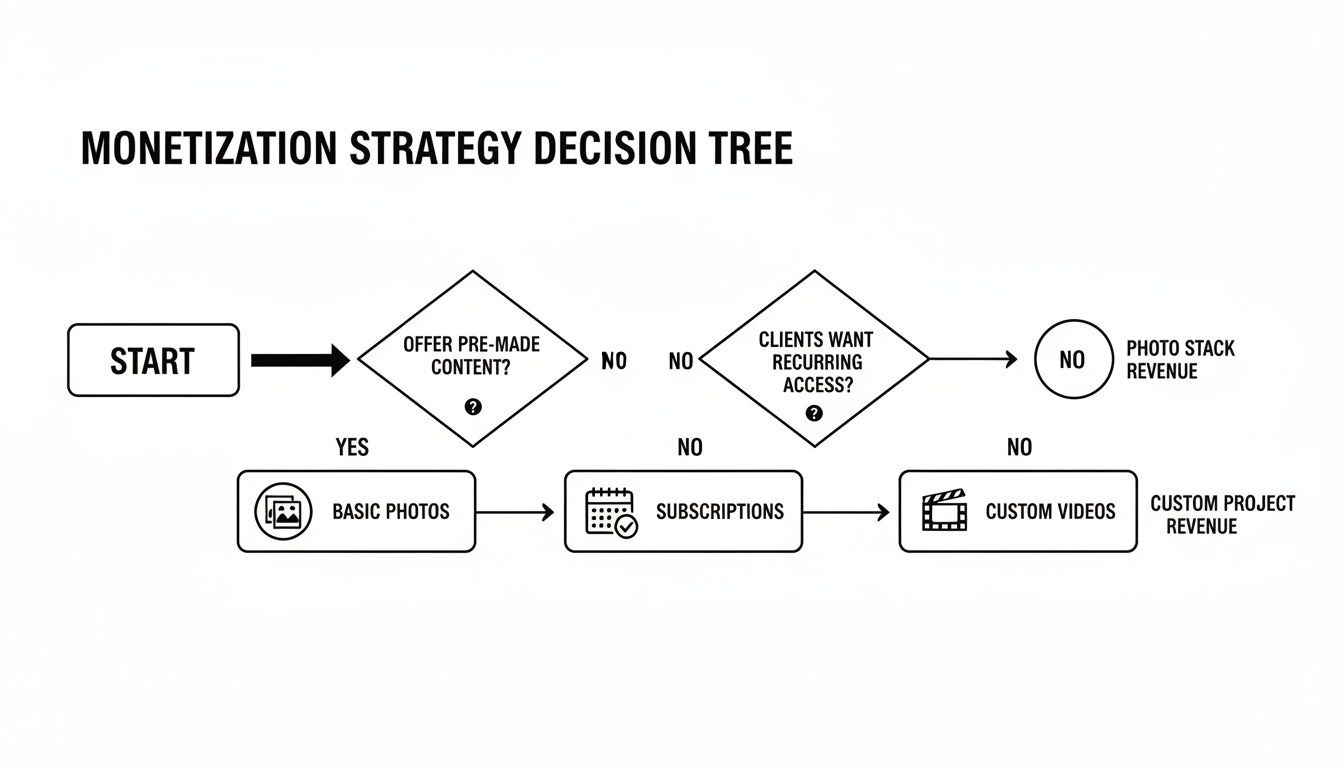
As you can see, your strategy will boil down to whether you prefer one-off sales or building a steady, recurring income stream through subscriptions.
My Recommendation For New Creators
For anyone just starting out, I usually recommend beginning on a specialized platform like FeetFinder. Why? The built-in, targeted audience dramatically lowers the barrier to entry, and the extra security features provide some much-needed peace of mind when you're learning the ropes.
Yes, there's a seller subscription fee, but I encourage you to think of it as an investment in a secure and pre-qualified marketplace. It helps weed out people who aren't serious and gives you a safer space to build your confidence.
Once you’ve got your footing and have a small following, you can always branch out to other platforms like OnlyFans or even social media. Diversifying is a great long-term strategy in my book. But I believe the smartest way to start is by putting your safety first.
Protecting Your Safety and Anonymity Online

Okay, let's talk about the single most important part of this whole venture. While making money is the goal, your personal safety and digital privacy are absolutely non-negotiable. I can't stress this enough: protecting yourself isn't just a smart move—it’s the entire foundation of a sustainable, stress-free side hustle.
The internet offers this incredible ability to build a totally separate, anonymous persona, but that wall of privacy doesn't build itself. You have to construct it, piece by piece. I like to think of it like building a digital fortress; every single action you take either reinforces your walls or leaves a gate wide open.
Building Your Anonymous Brand
Your first move is to create a digital identity that has zero connection to your real life. This goes way beyond just picking a catchy name. It’s about creating a complete and total separation between your creator life and your personal life. No overlap.
From what I've seen, your main line of defense comes down to a few critical, non-negotiable rules.
Create a Pseudonym: Your creator name shouldn't link back to your real name, any nicknames you go by, or other online handles you use elsewhere.
Use a Separate Email: Set up a brand-new email address that you use only for your creator business. Don't even think about using your personal or work email.
Avoid Showing Your Face: This is the golden rule. Keeping your face out of your content makes it incredibly difficult for anyone to connect your online persona to your real-world identity.
These first steps are simple, but they're incredibly powerful. They draw a clear line in the sand from day one, making it much harder for anyone to dig up personal information you haven't chosen to share. It's all about controlling your own narrative.
Staying safe is an active process, not a passive one. You are the gatekeeper of your own information. I believe every decision, from the payment app you use to the background of your photos, contributes to your overall security.
Safeguarding Your Digital Footprint
Beyond your brand identity, you need to get a handle on the technical details that can accidentally give you away. What a lot of people don't realize is that every photo you snap with your smartphone contains a treasure trove of hidden data. This is where you have to be extra vigilant.
One of the biggest culprits I see is EXIF data, which is metadata automatically embedded in your image files. This data can include the exact GPS coordinates of where the photo was taken, the make and model of your phone, and even the precise date and time. Wiping this data clean before you upload anything is absolutely essential.
Here’s a practical checklist I've developed for locking down your content and communications:
Remove Photo Metadata: Before a picture ever goes online, use a free EXIF data remover (there are plenty of websites and apps) to strip out all that identifying information.
Use Platform Payment Systems: I must insist: never, ever use personal payment apps like Cash App or Venmo where your real name could be exposed. Stick to the built-in payment systems on platforms like FeetFinder, which are designed to keep both you and the buyer anonymous.
Be Mindful of Backgrounds: Pay close attention to what’s going on behind your feet. Avoid showing anything that could pinpoint your location, like mail on a table, unique landmarks out a window, or even family photos on the wall.
Setting Boundaries and Spotting Red Flags
Your safety isn't just about tech—it’s about how you manage your interactions with clients. You are in complete control here, and setting firm boundaries right from the start is crucial. I advise you to state exactly what you are and are not comfortable with in your profile bio.
Unfortunately, you're going to run into scammers and people looking to waste your time. Learning to spot them quickly will save you a ton of headaches.
I recommend you keep an eye out for these common red flags:
Refusing Upfront Payment: Any buyer who tries to get content before paying is a major red flag. No exceptions.
Pushing Boundaries: If a client repeatedly asks for content you've clearly stated you don't offer, they don't respect your rules. It's time to block and move on.
Offering "Chargebacks" or Suspicious Deals: Scammers love to promise huge sums of money through weird, convoluted payment schemes. Stick to the secure, proven methods on whatever platform you're using.
Getting these safety protocols down is what separates a short-lived experiment from a successful, long-term business. When you know you’re secure, you can focus on what really matters—creating great content and building your brand with confidence.
Exploring the Untapped Commercial Market
When most people hear “selling feet pics,” their minds go straight to the fetish market. And sure, that’s a big part of the landscape. But I've found there’s a whole other world of opportunity that new creators often miss entirely: the commercial market. This is where a side hustle can start looking more like a real content creation business.
Just stop and think for a second. Who else needs high-quality, authentic pictures of feet? The list I've compiled is surprisingly long. Footwear brands, podiatry clinics, nail polish companies, and jewelry designers making anklets—they all need images for their websites, social media, and ad campaigns.
What’s really interesting to me is that these businesses are starting to ditch the sterile, lifeless stock photos they’ve used for years. They’re looking for real, relatable content that actually connects with customers. And that’s exactly what an independent creator can offer.
Pivoting to a B2B Model
This shift opens the door to a business-to-business (or B2B) model. Instead of selling one-on-one to individual customers, you’re providing a valuable service to other companies. It’s a great way to build different income streams and work in a more professional, less personal space.
And the demand is growing fast. Based on my research, foot photography's commercial use just saw a 37% year-over-year revenue jump for creators, which outpaced broader photography niches by 12 percentage points. The most telling statistic? A huge 68% of that growth came from B2B deals. Brands in footwear, orthopedics, and wellness are buying up custom foot content to replace their old, boring stock images. You can get more of the nitty-gritty in my deep dive into monetizing foot photography.
The shift I'm seeing is clear: brands are tired of the same old, polished stock images. They're actively seeking independent creators who can provide authentic, high-quality content that feels real and engaging. This is your opening.
What Commercial Clients Are Looking For
A commercial client’s needs are a world away from a private buyer's. The focus here is on clean, professional shots that showcase a product or a specific concept.
Here’s a taste of what I know these businesses are after:
Product Shots: Your feet modeling a new pair of sandals, wearing a specific brand of socks, or showing off a fresh pedicure with a featured nail polish.
Lifestyle Content: Images that tell a story. I've seen brands request feet relaxing by a pool for a travel company, feet in hiking boots on a trail for an outdoor gear brand, or feet propped up with a cozy blanket for a wellness blog.
Medical and Wellness Imagery: Podiatrists and orthotics brands often need clear, well-lit photos. These could be used to demonstrate foot stretches, show how an insert fits, or illustrate common conditions in a tasteful, clinical way.
Beauty and Aesthetics: Nail salons and jewelry makers want close-ups that make their work shine—perfectly polished toes, elegant toe rings, or delicate anklets.
Pricing and Positioning for Brand Deals
When you start working with businesses, your pricing has to change. You’re not just selling a picture anymore; you’re licensing your content for commercial use, which means it’s going to be seen by a much wider audience. That means you should charge significantly more than you would for a personal custom request.
A good first step is to create a simple portfolio or a one-page "media kit" that shows off your best work. I recommend you make sure the images are clean, well-lit, and high-resolution. When you reach out to brands or when they find you, be ready to offer packages. For example, you could offer a set of 10 images for a flat fee or a monthly retainer for a steady stream of new content.
Taking this professional approach elevates you from being a niche creator to a versatile digital entrepreneur. It proves that the answer to "can you make money selling feet pics?" is much bigger and more complex than most people ever imagine.
Got Questions? Let's Get Them Answered
To wrap things up, let's tackle some of the most common questions I hear from people just starting out. Getting these cleared up can bust a few myths and give you the confidence you need. Here are some straight-to-the-point answers to help you get started on the right foot.
Do I Need a Fancy Camera to Get Started?
Absolutely not. This is probably the biggest thing that I see holding people back. While a pro setup is a nice goal for later, most top sellers get their start using nothing more than their smartphone. Seriously, the camera in your pocket is more than enough to capture great shots.
What really makes a difference is good lighting—and I find you can't beat the natural light from a window. Combine that with a clean, simple background and a little bit of creativity, and you're golden. The focus should be on taking crisp, high-quality photos and figuring out the poses and angles your audience is looking for. Your effort and consistency will always beat expensive gear.
How Much Should I Charge for My Pictures?
Figuring out your pricing is part art, part science. I always tell new creators to start by doing a little window shopping. Hop on a platform like FeetFinder and see what other sellers with a similar style are charging. That’ll give you a realistic ballpark to start with.
If you need a general guideline, here’s a common starting point I've observed:
Basic Photo Sets: These usually go for anywhere from $5 to $25.
Custom Photos: Since these are made-to-order, they fetch more, typically $10 to $50 a pop, depending on the request.
Videos: Video content naturally costs more, starting around $25 and going up to $100+ for custom clips.
I want you to remember to value your time and effort, especially when it comes to custom work. You can always raise your prices as you build a following and get more experience. It’s perfectly fine to start small and adjust as you grow.
Is Selling Feet Pics Actually Legal?
Yes, it is perfectly legal for consenting adults in the United States and most other countries to sell photos of their own feet. There are a couple of non-negotiable rules, though. You must be over 18, and you must own the content you're selling. Using someone else's images or involving a minor is illegal, full stop.
This is why trusted platforms like FeetFinder and OnlyFans are so strict about verifying the age of both creators and buyers. And one last thing—don't forget about taxes. This is real income, and you need to treat it that way. I always advise people to think of it as a freelance business and report their earnings accordingly. Your side hustle is a business, and the IRS will want its cut.
At Circle City News™, I provide candid, informed reporting on the creator economy and its intersection with local life. For more of my deep dives into the adult entertainment industry, trends, and legal analysis, check out our latest articles at https://circlecitynews.org.
Comments